

Atomic Habits Summary + Cheat Sheet: The 4 Laws on One Page
Here's the Atomic Habits summary in short: the book, by James Clear (2018), says big changes come from small habits repeated over time, and that you change habits by changing the system around you, not by relying on willpower. Its core tool is the four laws of behavior change: to build a habit, make it obvious, attractive, easy and satisfying. To break one, make it invisible, unattractive, difficult and unsatisfying.
Below you'll get the four laws as a cheat sheet, one habit worked through all of them, the book's key ideas in plain English, and the mistakes people make when they try to use it. The one-page cheat sheet is free to print.
The problem with Atomic Habits isn't the book. It's that most people read it, nod at every page, and change nothing. The fix is to run one real habit through it, start to finish. So that's how this summary is built.
What are the 4 laws of Atomic Habits?
Every habit, in Clear's model, runs on a loop: cue, craving, response, reward. Something prompts you, you want the result, you do the thing, and you get the payoff. Each law targets one step.
Step | To build a good habit | To break a bad habit |
|---|---|---|
Cue | 1. Make it obvious | Make it invisible |
Craving | 2. Make it attractive | Make it unattractive |
Response | 3. Make it easy | Make it difficult |
Reward | 4. Make it satisfying | Make it unsatisfying |
Law 1 - Make it obvious. Decide exactly when and where the habit happens, and put the cue in your path. The book's formula: "I will [behavior] at [time] in [location]."
Law 2 - Make it attractive. Link the habit to something you already want. The book calls one version temptation bundling: only do the thing you enjoy while doing the thing you need to do. It also points out that we copy the habits of the people around us, so spending time with people who already do the habit helps. To break a habit, flip it: spell out what the habit costs you, so it looks less appealing.
Law 3 - Make it easy. Cut the steps between you and the habit. The 2-minute rule: when you start a new habit, scale it down until it takes less than two minutes to do. "Read before bed" becomes "read one page."
Law 4 - Make it satisfying. Give yourself an immediate payoff, because the brain repeats what feels good right away. A habit tracker counts: ticking the box is the reward.
One habit, all four laws: a worked example
Here's a hypothetical person who wants to read before bed and stop scrolling in bed. Same evening, both directions.
Law | Build: read before bed | Break: phone in bed |
|---|---|---|
Obvious / invisible | Book on the pillow every morning. "I will read at 10:15 pm in bed." | Notifications off after 9 pm, phone face down and out of sight |
Attractive / unattractive | Pick a book they actually want to read, not one they think they should | Write one line about how they felt after last night's scroll, and read it before opening the app |
Easy / difficult | The 2-minute version: read one page | Phone charges in the kitchen and the app is logged out, so scrolling means getting up and typing a password |
Satisfying / unsatisfying | Tick the box on a tracker by the bed | A friend gets a text from them every time they break the rule |
None of these need more willpower at 10 pm. They change what's easy at 10 pm. That's the book's main point in one table.
The key ideas in Atomic Habits, in plain English
1% better. Small improvements add up. Clear's illustration: get 1% better every day for a year and you end up about 37 times better. Get 1% worse every day and you end up near zero. It's an illustration, not a forecast, but the point holds: small habits matter because they repeat.
Systems over goals. Winners and losers often have the same goals. What's different is the system: the daily process. Set the goal, then spend your attention on the system.
Identity-based habits. Start with who you want to become, not what you want to get. "I'm a reader" instead of "I want to read 20 books." Each time you do the habit, it's a small piece of proof for that identity. Keeping small promises to yourself is also how self respect is built. If the voice in your head says "I'm just not that kind of person", that's a fixed mindset talking; here's growth mindset vs fixed mindset in plain words, with a phrase swap sheet.
The Plateau of Latent Potential. Results lag behind effort. The book's example is an ice cube in a cold room: you warm the room one degree at a time and nothing happens, until the ice reaches its melting point. Early weeks of a habit often look like nothing is working.
Habit stacking. Attach a new habit to one you already do. The formula: "After [current habit], I will [new habit]." After I pour my morning coffee, I will write my top task for the day.
Environment design. Make good cues visible and bad cues hard to see. Fruit on the counter, the guitar on a stand in the living room, the phone in a drawer.
The Habits Scorecard. List your daily habits from waking up to bed, then mark each one as positive (+), negative (-) or neutral (=). You can't change what you don't notice.
The Goldilocks Rule. Motivation tends to be highest when a task sits at the edge of your current ability: not too easy, not too hard.
Never miss twice. Missing once is an accident. Missing twice starts a new pattern. The full rule, and how to use it, is in never miss twice.
Free printable: the Atomic Habits cheat sheet
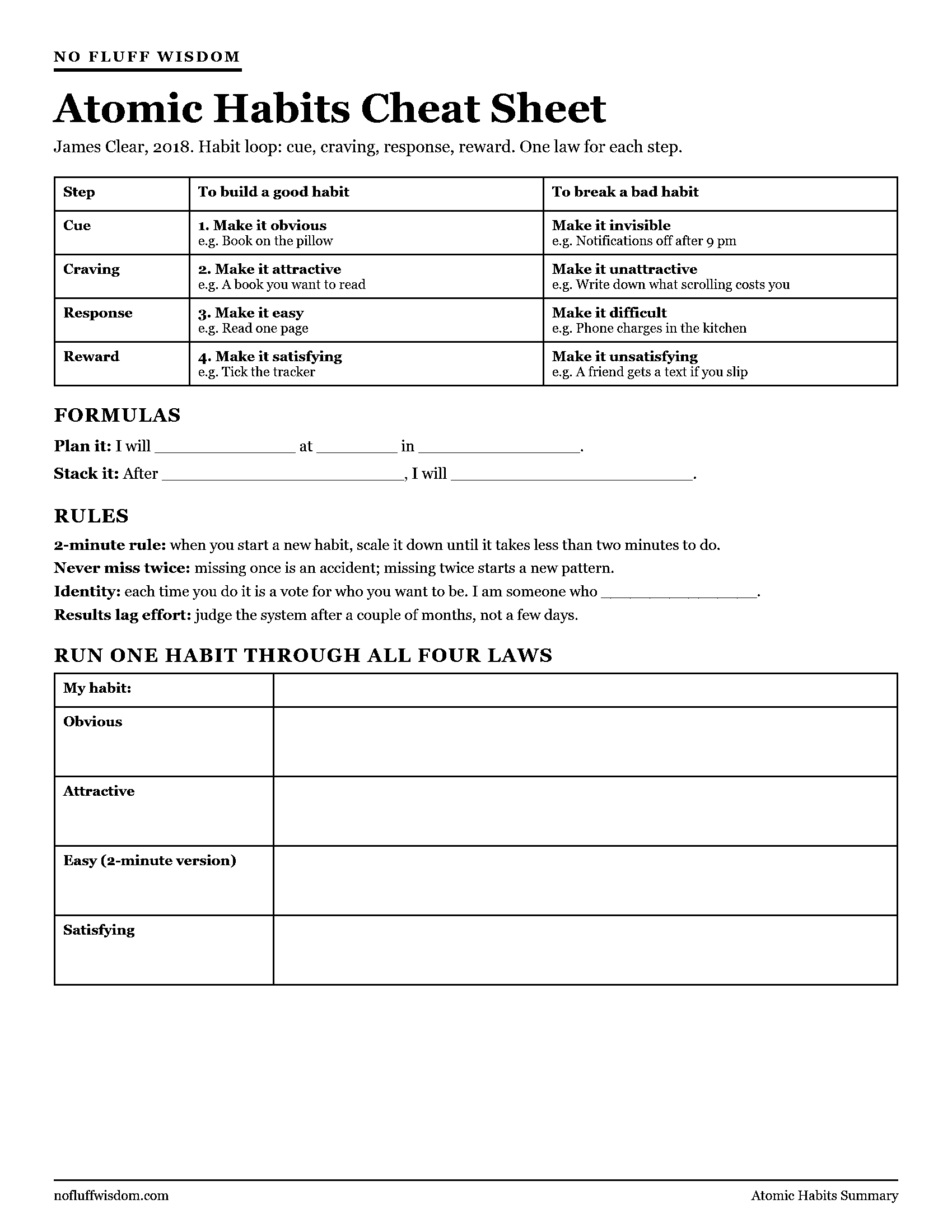
Right-click (or long-press) the image to save it, then print it on US Letter or A4 and choose "fit to page".
One page. The four laws with build and break columns, the two formulas (stacking and "I will... at... in..."), the 2-minute rule and never miss twice. At the bottom there's an empty row where you run one of your own habits through all four laws.
Fill in that row first. Reading the sheet isn't the point. Using one line of it is.
The cheat sheet sets up one habit. Keeping it, and adding the next one without everything falling apart, is the longer job. The Execution Bundle covers that: both NoFluffWisdom books together. The 90-Day Discipline Blueprint adds habits in order over 12 guided weeks, with a printable 90-Day Tracker, a Mindset Script Collection for cravings and setbacks, and a Restart Plan. 7 Steps to Change Your Life covers seven habits worth building, from lifting weights to reading, with a daily tracker. 25% off with code 25off.
What do people get wrong when they use Atomic Habits?
This part is our opinion, from how people tend to apply the book.
They change five habits at once. The book is full of ideas, so people try them all. Pick one habit and run it through the four laws first.
They treat the 2-minute rule as the whole habit. Two minutes is how you start. One page of reading is the doorway, not the destination. Once it's automatic, let it grow.
They skip Law 3 and lean on Law 2. Making a habit exciting fades fast. Making it easy lasts. If you only change one thing, cut the steps.
They expect results in week two. That's the Plateau of Latent Potential. Judge the system after a couple of months, not after a few days. If you want a way to see progress before results show up, use a habit tracker.
They can't change their environment. The book assumes you control your space. Shared homes, office desks and family schedules make that harder. When you can't move the cue, change your timing instead: do the habit before the environment gets busy.
Is Atomic Habits worth reading?
Yes, if you want one practical book on habits. It's short, clear and full of examples, and the four laws give you a tool you can reuse for any habit.
Two honest caveats. A lot of the book is stories and examples rather than research detail, so treat it as a practical guide, not a science textbook. And if you've read other habit books, much of it will feel familiar. Its strength is that it puts the ideas in one clear, usable order.
If you liked the idea of a one-page summary, the 7 Habits of Highly Effective People summary takes the same approach to Covey's book.
FAQ: Atomic Habits
What is Atomic Habits about?
How small habits add up to big changes, and how to build good habits and break bad ones by changing your environment and system rather than relying on motivation.
What are the 4 laws of behavior change?
Make it obvious, make it attractive, make it easy, make it satisfying. To break a habit, invert them: make it invisible, unattractive, difficult and unsatisfying.
What is the 2-minute rule?
When you start a new habit, scale it down until it takes less than two minutes. "Do 30 minutes of yoga" becomes "take out your yoga mat." The goal is to make starting automatic.
What is the habit stacking formula?
"After [current habit], I will [new habit]." You use a habit you already do every day as the cue for the new one.
How do you break a bad habit with Atomic Habits?
Use the inversions. Hide the cue, make the habit less appealing, add steps so it's harder to do, and attach a cost so it feels bad right away.
If you want the 90-day plan for making one habit last, both books are in one bundle. 25% off with code 25off.
In the next 10 minutes: pick one habit, write its "I will... at... in..." sentence, and do the 2-minute version today.