

Habits to Track: 50 Ideas + Free Habit Tracker Printable
The best habits to track are small, daily, and easy to answer with a yes or no: drank water, walked 20 minutes, read 10 pages, phone out of the bedroom. Start with three, not ten. Track each one right after you do it, and write down a smaller version for bad days.
Below are 50 habits to track, grouped by life area, a quick way to pick your first three, and a free printable monthly habit tracker.
A habit tracker doesn't build the habit. It shows you the truth about it.
That's useful only if the page stays honest. Track too many things and you stop filling it in. Track vague things ("be healthier") and you can't tell if you did them. So the list below is built for tracking: every habit is specific, and every one comes with a minimum version.
50 habits to track (by life area)
The minimum version is what counts on a bad day. It keeps the streak alive and the habit in place, even when the full version isn't happening.
Health
Habit to track | Minimum version |
|---|---|
Drink 8 glasses of water | 1 glass before each meal |
Walk 20 minutes | Walk 5 minutes |
Vegetables with lunch and dinner | Vegetables with one meal |
No food 2 hours before bed | No snacks after dinner |
Take vitamins or medication | Take them, no minimum needed |
Floss | Floss 2 teeth |
Stretch 10 minutes | Stretch 2 minutes |
Fitness
Habit to track | Minimum version |
|---|---|
Workout | 10 push-ups or a 10-minute walk |
Strength training (2-3x a week) | One set of each move |
Steps (pick a number) | Half the number |
Run | Put on the shoes and run 5 minutes |
Morning mobility | 1 minute |
Sleep
Habit to track | Minimum version |
|---|---|
In bed by a set time | Within 30 minutes of it |
Phone out of the bedroom | Phone across the room |
Same wake-up time | Within 30 minutes of it |
No caffeine after 2 pm | No caffeine after 4 pm |
Screens off 30 minutes before bed | 10 minutes |
Mind
Habit to track | Minimum version |
|---|---|
Journal | 3 lines |
Meditate | 2 minutes |
Read | 1 page |
Gratitude | One specific thing |
Time outside | 5 minutes |
Learn something new | 5 minutes of a lesson |
Productivity and focus
Habit to track | Minimum version |
|---|---|
Hardest task first | 10 minutes on it |
Plan tomorrow tonight | Write the top task |
One focus block | 25 minutes |
Inbox zero | Clear 10 emails |
Weekly review (Sunday) | 5 minutes |
No phone for the first hour | First 15 minutes |
Shutdown routine | Write tomorrow's first task |
Money
Habit to track | Minimum version |
|---|---|
Track spending | Write today's total |
No unplanned purchases | Wait 24 hours |
Bring lunch | Bring a snack |
Check your account | Open the app and look |
Save something | Move any amount |
Relationships
Habit to track | Minimum version |
|---|---|
Message a friend | One text |
Call family | 2-minute call |
Phone-free dinner | Phone face down |
Say thank you to someone | One person |
Quality time with partner or kids | 10 minutes |
Home
Habit to track | Minimum version |
|---|---|
Make the bed | Pull up the cover |
Dishes done before bed | Load what's in the sink |
15-minute tidy | 5 minutes |
Laundry on schedule | Start one load |
Bad habits to track (avoidance habits)
Track the days you didn't do it. A tick means a clean day.
Habit to stop | Tick the box if you... |
|---|---|
Doomscrolling | Didn't scroll in bed |
Snoozing | Got up on the first alarm |
Alcohol | Had none, or stayed at your limit |
Takeout | Ate at home |
Nail biting | Didn't bite |
Late-night snacking | Stopped eating after dinner |
That's 50. Don't track all of them. Pick three.
How many habits should you track?
Start with three. Add a fourth only after a month where you filled in most days.
Three is enough to change a month, and few enough to fill in every night in under a minute. More rows usually mean more empty boxes, and empty boxes make it easy to quit the whole tracker.
To pick your three, use one from each group:
One you already mostly do. Making the bed, taking vitamins. It gets you opening the tracker every day and gives you an easy first tick.
One you're building. The habit you actually care about this month: the workout, the reading, the saving.
One you're stopping. Pick from the avoidance list. It shows you how often the bad habit really happens.
If you've written resolutions for next year, take the weekly action from your first one as habit number two. The 2027 resolution ideas and worksheet has a list.
Free printable: monthly habit tracker
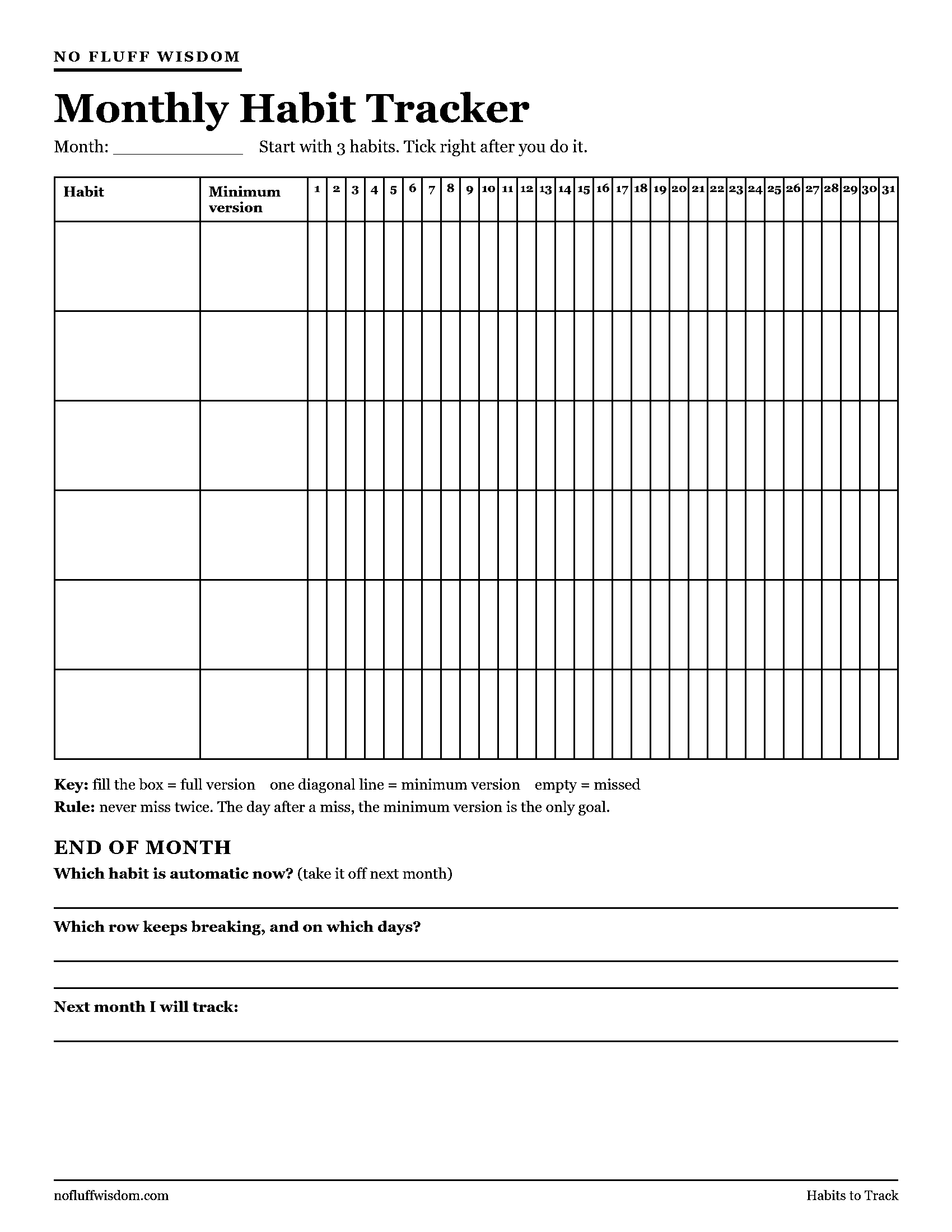
Right-click (or long-press) the image to save it, then print it on US Letter or A4 and choose "fit to page".
One page, one month. Six rows, so you have room for three habits now and a few more later. Each row has space for the habit and its minimum version, then 31 boxes.
How to use it:
Write each habit and its minimum version in the left column.
Tick the box right after you do the habit, not at the end of the week. Memory isn't a tracker.
Full version done: fill the box. Minimum version done: a single diagonal line. Missed: leave it empty.
At the end of the month, count the ticks and answer the two questions at the bottom.
Prefer an app or a notebook? The same rules work anywhere: three habits, a minimum version, tick right after. In a notebook, the tracker is one of the first pages in these bullet journal ideas. And if journaling is one of your three, here's how to start a journal with three lines a night.
A month on paper shows you which habits stick. Running them for a whole season is the harder part, and that's where The Execution Bundle helps: both NoFluffWisdom books together. The 90-Day Discipline Blueprint builds habits in order, one main habit in weeks 1-2, a second in weeks 3-4, a third in weeks 7-8, with its own printable 90-Day Tracker and a Restart Plan. 7 Steps to Change Your Life covers seven habits worth building first, with a daily tracker. 25% off with code 25off.
What does a good month on the tracker look like?
Here's a hypothetical month for someone tracking three habits:
Habit | Minimum version | Full days | Minimum days | Missed |
|---|---|---|---|---|
Make the bed | Pull up the cover | 27 | 2 | 1 |
Workout | 10 push-ups | 11 | 9 | 10 |
No phone in bed | Phone across the room | 16 | 4 | 10 |
That isn't a perfect month. It's a useful one.
The bed is automatic now, so next month it can come off the tracker. The workout happened 20 days out of 30, counting the minimum days, which is a lot more than "I never work out." And the phone row shows a real problem: 10 nights in bed with the phone. That's next month's focus.
What should you do when you miss a day?
Do the minimum version the next day. That's the whole rule.
One empty box is normal. Two in a row is where habits slip away, so the day after a miss, the only goal is a tick, even a small one. The longer version of this is never miss twice.
Don't fill in boxes you missed, and don't start a fresh page because one week went badly. The gaps are information. They show you which days, or which weeks, keep breaking the habit. If whole weeks are empty because you're running on empty, the habit isn't the problem; start with how to recover from burnout.
FAQ: habits to track
What should I track in a habit tracker?
Daily habits you can answer with yes or no: water, a walk, reading, bedtime, phone out of the bedroom. Avoid vague ones like "be healthy". If you can't tell whether you did it, you can't track it.
What are the best habits to track for beginners?
Pick one you already mostly do (make the bed), one you're building (a 10-minute walk), and one you're stopping (no phone in bed). Three is enough.
How long does it take to form a habit?
It varies a lot. A University College London study (Lally and colleagues, 2010) found that a new daily behavior took a median of 66 days to become automatic, with a range of 18 to 254 days depending on the person and the habit. Plan to track for at least two months.
Is it better to track habits on paper or in an app?
Whichever you'll open every day. Paper is visible on a fridge or desk, which helps. An app is always with you. A printed tracker is a good place to start because it's free and has no notifications to ignore.
Should I track habits on weekends?
Track the habits you want every day, including weekends. For weekday-only habits, cross out the weekend boxes at the start of the month so they don't look like misses.
Three ticks a night is how habits start. If you want the 90-day plan for making them stick, both books are in one bundle. 25% off with code 25off.
Right now, in under 10 minutes: pick your three habits from the list, write each one's minimum version, and print the tracker for the rest of this month.