

Growth Mindset vs Fixed Mindset: Examples + Free Phrase Swap Sheet
Growth mindset vs fixed mindset comes down to what you believe about ability. With a fixed mindset, you see talent and intelligence as set, so failure feels like proof of your limits. With a growth mindset, you see ability as something that improves with practice, better methods and help, so failure is information about what to change.
The terms come from Stanford psychologist Carol Dweck, who wrote about them in her book Mindset: The New Psychology of Success (2006). Below: a side-by-side comparison, everyday examples, what the research does and doesn't show, and a printable phrase swap sheet with a short self-check.
What is the difference between a growth and fixed mindset?
Situation | Fixed mindset | Growth mindset |
|---|---|---|
A hard task | "If I struggle, I'm not cut out for it." | "Struggling means I'm at the edge of what I can do. That's where I learn." |
Effort | Needing effort means you lack talent | Effort, plus the right method, is how skill is built |
Failure | Proof of a limit | Information about what to change |
Feedback | Feels like an attack | Tells you what to fix |
Someone else's success | A threat, or proof you're behind | A source of methods to learn from |
Trying new things | Avoid them in case you look bad | Try them, expect to be bad at first |
What you say | "I'm just not a math person." | "I'm not good at this yet." |
The table makes it look like two kinds of people. It isn't. Dweck has said that everyone is a mix of both, and most people have triggers that pull them into fixed thinking: criticism, a new skill, watching someone better.
Fixed mindset vs growth mindset examples
Same moment, two ways of reading it.
At work. Your manager sends your report back with changes.
Fixed: "They think I'm bad at my job."
Growth: "Which of these changes will I need again? Let me write them down."
At school. You get a C on a test.
Fixed: "I'm not smart enough for this subject."
Growth: "What kind of questions did I lose marks on? I'll practice those first."
In fitness. You can't do a single pull-up.
Fixed: "My body isn't built for this."
Growth: "What's the easier version? I'll start with hangs and negatives."
Learning a skill. Your first week of guitar sounds awful.
Fixed: "Some people are musical. I'm not."
Growth: "Everyone sounds like this in week one. Fifteen minutes a day, then I'll check again in a month."
In relationships. A friend tells you that you hurt them.
Fixed: "I'm not a bad person, so they're wrong."
Growth: "I didn't mean to, but it happened. What would I do differently?"
Notice the growth version usually ends in an action. That's the part that matters.
Can you change a fixed mindset?
Yes, but not by repeating "I have a growth mindset". The change happens in a three-step loop, at the moment the fixed thought shows up:
Catch it. Notice the fixed thought, word for word. "I'm just not good at this."
Swap it. Say the growth version out loud. "I'm not good at this yet."
Act on it. Do one small thing the growth version points to, within the next ten minutes.
Step three is where most advice stops short. A new sentence without a new action is just positive thinking. The action is what slowly gives you evidence that you can improve, and that evidence is what shifts the belief.
Free printable: growth mindset phrase swap sheet
The sheet has eight common fixed thoughts, a growth swap for each, and a next action. Below that is a six-question self-check to find where fixed thinking shows up most for you, and a box to plan this week's swap.
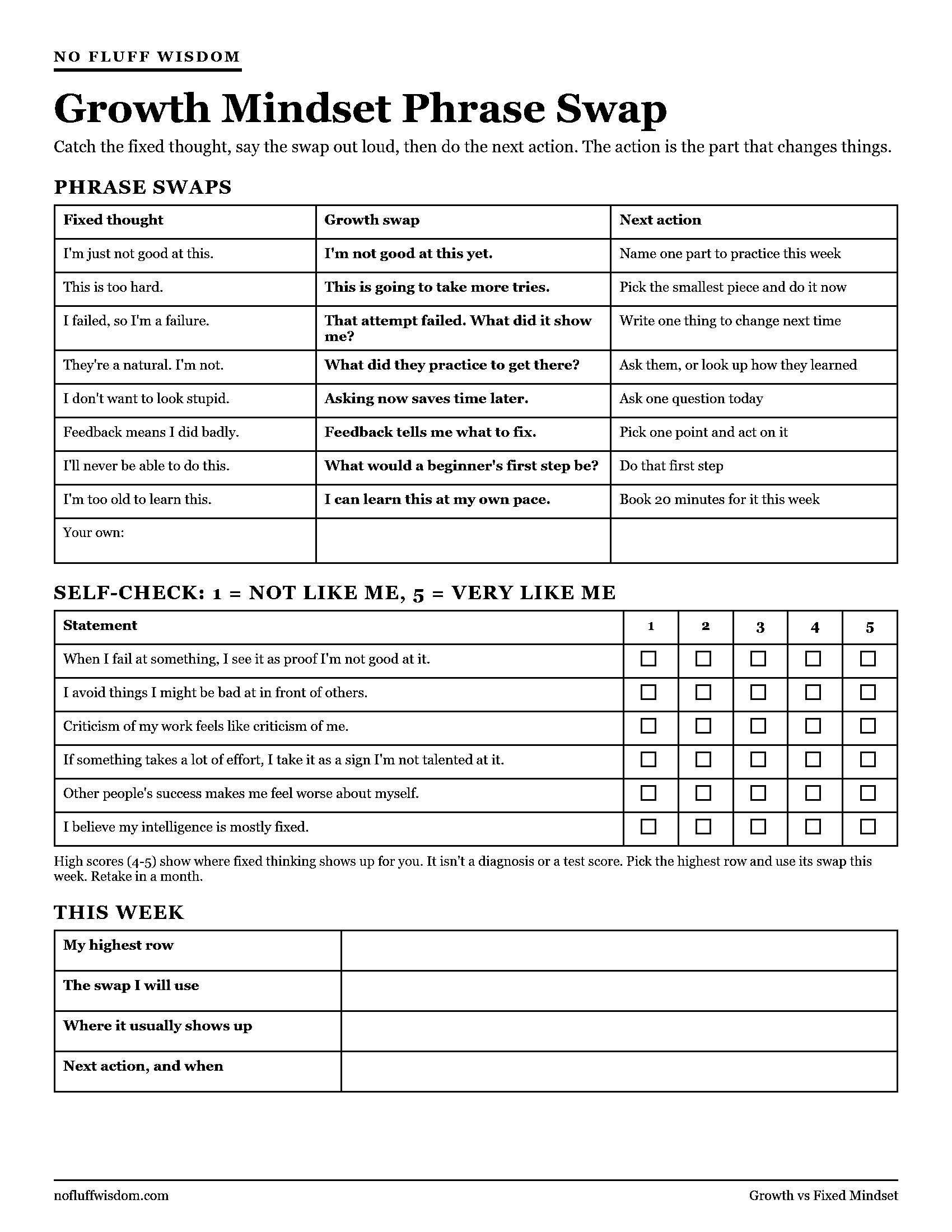
Right-click (or long-press) the image to save it, then print it on US Letter or A4 and choose "fit to page".
Text version:
Fixed thought | Growth swap | Next action |
|---|---|---|
I'm just not good at this. | I'm not good at this yet. | Name one part to practice this week |
This is too hard. | This is going to take more tries. | Pick the smallest piece and do it now |
I failed, so I'm a failure. | That attempt failed. What did it show me? | Write one thing to change next time |
They're a natural. I'm not. | What did they practice to get there? | Ask them, or look up how they learned |
I don't want to look stupid. | Asking now saves time later. | Ask one question today |
Feedback means I did badly. | Feedback tells me what to fix. | Pick one point and act on it |
I'll never be able to do this. | What would a beginner's first step be? | Do that first step |
I'm too old to learn this. | I can learn this at my own pace. | Book 20 minutes for it this week |
Self-check. Rate each from 1 (not like me) to 5 (very like me):
When I fail at something, I see it as proof I'm not good at it.
I avoid things I might be bad at in front of others.
Criticism of my work feels like criticism of me.
If something takes a lot of effort, I take it as a sign I'm not talented at it.
Other people's success makes me feel worse about myself.
I believe my intelligence is mostly fixed.
Your highest-rated rows show where fixed thinking shows up for you. It's not a diagnosis or a test score, just a place to start. Pick your highest row, choose the swap from the sheet that fits it best, use it this week, and retake the check in a month.
A phrase swap works in the moment. If you want more scripts like these, The Execution Bundle has both NoFluffWisdom books together. The 90-Day Discipline Blueprint includes a Mindset Script Collection for negative thoughts and setbacks, plus 12 guided weeks and a Restart Plan. 7 Steps to Change Your Life has a whole habit on failing and learning from mistakes. 25% off with code 25off.
A worked example
Hypothetical example. Priya starts a new job that uses spreadsheets every day. In week one, a coworker builds in five minutes what takes her an hour.
Fixed thought she catches: "I'm just not a numbers person."
Swap: "I'm not good at spreadsheets yet."
Action within ten minutes: She writes down the three things the coworker did that she couldn't, and asks them which one to learn first.
Over the next month she learns one function a week. She's still slower than the coworker. But she's no longer avoiding spreadsheet tasks, and she has a list of what she can now do that she couldn't before. That list is the evidence. The belief follows it.
Is growth mindset debunked?
Not debunked, but the effects are smaller than the hype suggested. Here's what the research shows, honestly:
The big claims were overstated. A 2018 pair of meta-analyses (Sisk and colleagues, Psychological Science) found the link between mindset and school achievement was weak overall, and that mindset interventions had small average effects.
Some groups may benefit more. The same paper suggested students from lower-income backgrounds or already struggling at school might benefit more. A large US study in 2019 (Yeager and colleagues, Nature), with over 12,000 ninth graders, found two short online sessions modestly improved grades for lower-achieving students, and the effect depended on the school.
Belief alone isn't enough. Dweck herself has warned about a "false growth mindset", such as praising effort when the method isn't working. Saying "yet" without changing anything is the same trap.
So treat it as a useful tool, not a cure-all. That's why the sheet above pairs every swap with an action.
What's the difference between neuroplasticity and growth mindset?
Neuroplasticity is a fact about the brain: it changes its connections when you learn and practice. A growth mindset is a belief about yourself: that your abilities can improve. Neuroplasticity is part of why the belief is reasonable. But knowing your brain can change doesn't make you practice. The practice still has to happen.
FAQ: growth mindset vs fixed mindset
What is an example of a fixed mindset?
Saying "I'm just not a math person" after a bad test and then avoiding math. The thought treats one result as a permanent fact about you, and the avoidance makes it come true.
What is the opposite of a fixed mindset?
A growth mindset: the belief that ability improves with practice, good methods and help from others.
Can you have both a growth and fixed mindset?
Yes. Most people have a growth mindset in some areas and a fixed one in others, and fixed thinking often shows up under stress or criticism. The goal is to notice your triggers, not to never have a fixed thought.
Who came up with growth and fixed mindset?
Carol Dweck, a psychologist at Stanford University. Her book Mindset: The New Psychology of Success came out in 2006.
How do I develop a growth mindset?
Catch the fixed thought, swap it for a growth version, then take one small action within ten minutes. Repeat. The actions build evidence that you can improve, and the belief follows. Writing a SMART goal for one skill gives those actions a direction.
If you want to go further on how beliefs about yourself shape what you do, the Atomic Habits summary covers identity-based habits, and the 7 Habits summary starts with being proactive: focusing on what you can control.
Mindset changes in small actions, one at a time. If you want a plan for the next 90 days, both books are in one bundle. 25% off with code 25off.
Right now, in under 10 minutes: take the six-question self-check, find your highest row, pick the swap that fits it, and write that swap on a sticky note where you'll see it tomorrow.
The NoFluffWisdom team