

7 Habits of Highly Effective People Summary + One-Page Sheet
Here's The 7 Habits of Highly Effective People summary in short: the book, by Stephen R. Covey (1989), says effectiveness starts inside you and works outward. The seven habits are: be proactive, begin with the end in mind, put first things first, think win-win, seek first to understand then to be understood, synergize, and sharpen the saw. The first three are about managing yourself, the next three about working with other people, and the last one about keeping yourself in shape to do the rest.
This summary covers each habit in plain English, the one tool from the book that matters most for it, and one move to try this week. There's also a free one-page sheet you can print, plus an honest look at what holds up and what feels dated.
Most summaries retell the book chapter by chapter. That's fine for a book report. It's not much use on a Tuesday. So every habit below ends with something to do.
What are the 7 habits, in order?
# | Habit | In one line | Stage |
|---|---|---|---|
1 | Be Proactive | You choose how you respond | Private victory (yourself) |
2 | Begin with the End in Mind | Decide what you want before you act | Private victory |
3 | Put First Things First | Do the important things before the urgent ones | Private victory |
4 | Think Win-Win | Look for deals where both sides gain | Public victory (with others) |
5 | Seek First to Understand, Then to Be Understood | Listen properly before you argue your case | Public victory |
6 | Synergize | Combine different views into a better answer | Public victory |
7 | Sharpen the Saw | Keep renewing your body, mind, heart and spirit | Renewal |
Covey frames the habits as a move from dependence (you take care of me) to independence (I take care of myself) to interdependence (we can do more together). Habits 1-3 get you to independence. Habits 4-6 build on that to work well with others. Habit 7 keeps the whole thing running.
The order matters. In Covey's view, you can't reliably keep promises to other people (habits 4-6) until you can keep them to yourself (habits 1-3).
Habit 1: Be Proactive
The idea: Between what happens to you and how you respond, there's a choice. Proactive people use it. Reactive people let moods, other people and circumstances decide for them.
The tool: The Circle of Concern and the Circle of Influence. Your Circle of Concern is everything you worry about: the economy, your boss's mood, the news. Your Circle of Influence is the part you can actually do something about. Proactive people spend their energy on the second circle, and it tends to grow.
Try this week: Catch yourself saying "I have to" or "there's nothing I can do." Rewrite it once a day as "I choose to" or "what I can do is." It sounds small. It shows you how often you hand the decision to someone else. The same catch-and-swap works on thoughts like "I'm just not good at this"; see growth mindset vs fixed mindset for a printable swap sheet.
Habit 2: Begin with the End in Mind
The idea: Know where you're going before you start, in your life and in each project. Otherwise you can climb the ladder fast and find out it's leaning against the wrong wall.
The tool: A personal mission statement. Covey asks you to write down what you want to be and do, and the values behind it, then use it to make decisions. He opens the chapter by asking you to imagine what you'd want people to say about you at your own funeral.
Try this week: Skip the full mission statement for now. Write three sentences: what you want to be known for at work, at home, and by yourself. Keep them where you plan your week. If you're not sure what you want, start with how to figure out what you want (members).
Habit 3: Put First Things First
The idea: Habit 2 decides what matters. Habit 3 makes sure it actually gets time.
The tool: The time management matrix, four quadrants split by urgent and important:
Urgent | Not urgent | |
|---|---|---|
Important | Quadrant I: crises, deadlines | Quadrant II: planning, exercise, relationships, learning |
Not important | Quadrant III: most interruptions, some meetings and emails | Quadrant IV: time-wasters |
Covey's point: effective people protect Quadrant II, the important things nobody is chasing them for. Ignore it long enough and those things turn into Quadrant I crises.
Try this week: On Sunday, plan the week before it starts. Put two Quadrant II blocks in your calendar first, before meetings and errands fill it: one for health, one for the thing you keep saying you'll get to. A one-page weekly planner printable with a Top 3 box makes this a 15-minute job.
Habit 4: Think Win-Win
The idea: In most relationships and deals, you don't have to choose between winning and letting the other person win. Look for an agreement where both sides gain.
The tool: The abundance mentality: the belief that there's enough to go around, so someone else's win isn't automatically your loss. The book also offers "Win-Win or No Deal": if you can't find an arrangement that works for both of you, agree not to do the deal at all.
Try this week: Before your next negotiation, even a small one like who does which chores, write down what the other person needs to walk away happy. Start the conversation there. If you usually end up on the losing side of these, start with how to stop people pleasing.
Habit 5: Seek First to Understand, Then to Be Understood
The idea: Most people listen with the intent to reply. Covey asks you to listen with the intent to understand, before you make your own case.
The tool: Empathic listening: repeat back what the other person said, and what they seem to feel, until they agree you've got it right. Only then explain your side.
Try this week: In one disagreement this week, say "So what you're saying is..." before you give your view. Keep going until the other person says "yes, exactly."
Habit 6: Synergize
The idea: When two people with different views really understand each other (Habit 5) and want both sides to win (Habit 4), they can often find a better answer than either started with.
The tool: The third alternative. Instead of my way or your way, ask: is there an option neither of us has thought of yet?
Try this week: Next time you're stuck between two options with someone, ask "What would a third option look like?" and give it two minutes before you go back to picking one.
Habit 7: Sharpen the Saw
The idea: The book tells the story of a man sawing a tree for hours with a blunt saw. Asked why he doesn't stop to sharpen it, he says he's too busy sawing. Habit 7 is taking the time to sharpen.
The tool: Renewal in four dimensions: physical (exercise, sleep, food), mental (reading, learning), social/emotional (relationships), and spiritual (values, reflection, nature, or faith).
Try this week: Pick one small action in each of the four and track them for seven days. A walk, 10 pages, a call to a friend, five quiet minutes. A one-page habit tracker is enough.
Free printable: the 7 Habits on one page
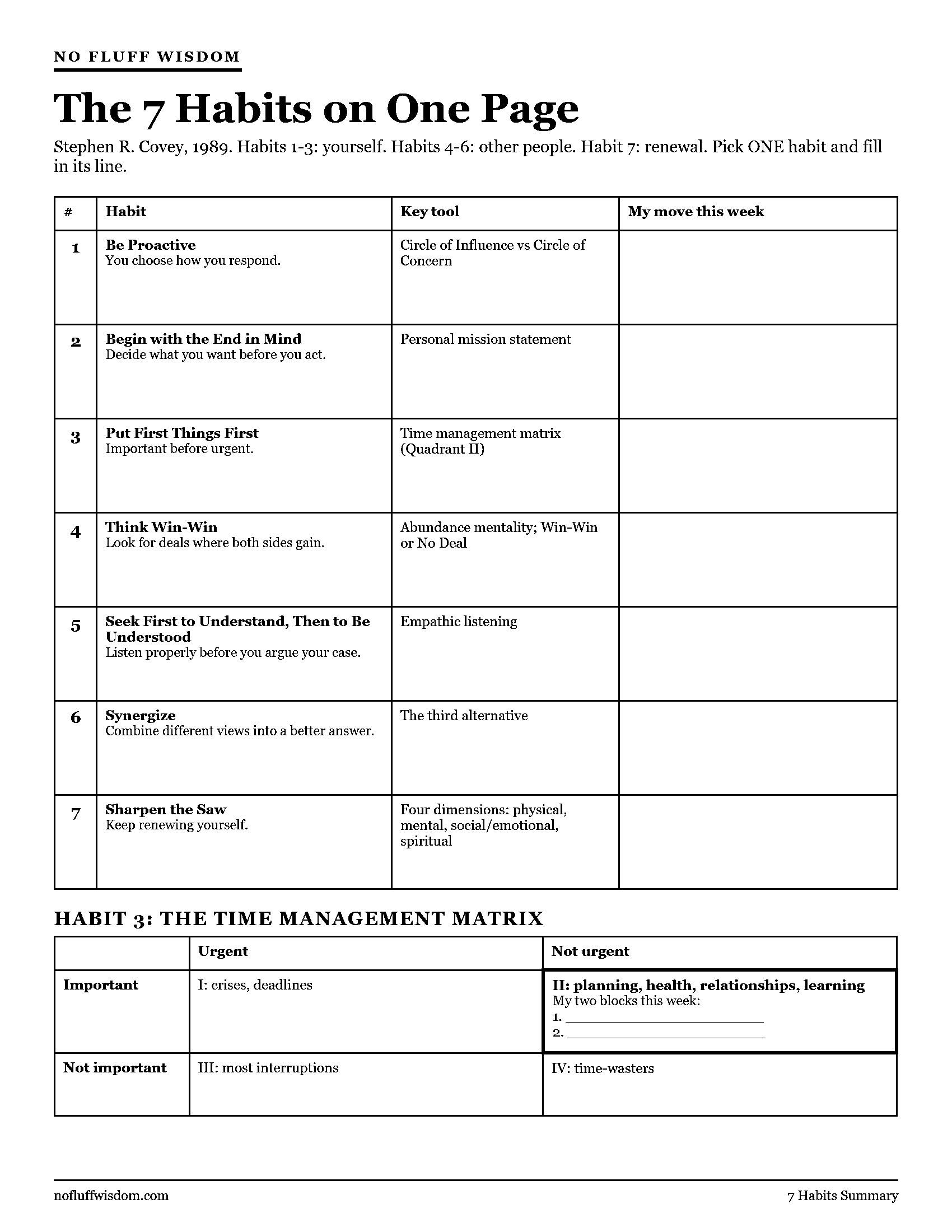
Right-click (or long-press) the image to save it, then print it on US Letter or A4 and choose "fit to page".
The sheet puts all seven habits on one page: the habit, what it means in one line, its key tool, and an empty line for your "this week" move. The time management matrix sits at the bottom, with space to write your two Quadrant II blocks.
Print it, pick one habit, and fill in only that line. Next week, pick another.
A one-page sheet keeps the book in front of you. Turning one habit into something you do for months takes more, and that's what The Execution Bundle is for: both NoFluffWisdom books together. The 90-Day Discipline Blueprint runs 12 guided weeks: one main habit in weeks 1-2, a second in weeks 3-4, a third in weeks 7-8, with a printable 90-Day Tracker. 7 Steps to Change Your Life covers seven habits, from reading to journaling, with prompts and templates. 25% off with code 25off.
What holds up, and what feels dated?
This part is our opinion, not the book's.
What holds up:
Habit 1 and the two circles. Putting your energy where you have influence is still one of the most useful ideas in self-help.
Habit 3's matrix. Urgent versus important is still the clearest way to see why busy weeks don't move anything.
Habit 5. Listening until the other person feels understood works in marriages, offices and customer calls.
What feels dated:
The setting. The book was written in 1989, and many examples come from that era's offices and family life. The ideas travel better than the examples.
It's long and abstract. The book spends a lot of pages on paradigms and principles before it gets practical. That's why summaries are so popular.
Win-win assumes good faith. Habits 4-6 work best when the other person is willing to play fair. With someone who isn't, "Win-Win or No Deal" matters more than synergy, and so does knowing how to set boundaries.
Where to start: If you only take one habit, take Habit 3. Planning the week around a few important blocks is easy to try, easy to check, and you'll know within a week whether it helped.
Is The 7 Habits of Highly Effective People worth reading?
Worth reading if you like to understand the why behind advice, and if you'll actually try the exercises. Skip the full book if you want quick tactics, and use the one-page sheet instead.
Either way, reading isn't the hard part. The test is whether one habit shows up in your week. If you tend to read books like this and move on, try running one idea for 7 days before you start the next one.
FAQ: The 7 Habits of Highly Effective People
What are the 7 habits of highly effective people?
Be proactive; begin with the end in mind; put first things first; think win-win; seek first to understand, then to be understood; synergize; and sharpen the saw.
Which of the 7 habits is the most important?
Covey treats Habit 1 as the foundation, because every other habit depends on choosing your response. In practice, Habit 3 is often the easiest to try and see results from in one week.
What is the main message of the book?
Lasting effectiveness comes from character, built from the inside out: first manage yourself (habits 1-3), then work well with others (habits 4-6), then keep renewing yourself (habit 7).
What are private and public victories?
Private victories (habits 1-3) are about mastering yourself: your choices, goals and priorities. Public victories (habits 4-6) are about working with other people. Covey argues the private ones come first.
What is Quadrant II?
The part of the time management matrix for things that are important but not urgent, like planning, exercise, relationships and learning. Habit 3 is about scheduling time for it before urgent tasks take over.
If you want the longer plan for keeping a habit past week one, both books are in one bundle. 25% off with code 25off.
In the next 10 minutes: open your calendar for next week and block two Quadrant II slots before anything else goes in, one for health and one for the thing you keep postponing.