

How to set boundaries without a fight
Short answer: To set boundaries, decide what you will and won't accept, say it once in one plain sentence, and then act on it if it's crossed. A boundary is about what you will do, not a rule for someone else. "I don't answer work messages after 7pm" is a boundary. "You can't message me after 7pm" is a demand. Start with one small limit, with one person, this week.
What are boundaries, and why do they matter?
A boundary is a limit that protects your time, energy, body, money or values. It tells people how to treat you and what happens when they don't.
Without boundaries, you end up agreeing to things you resent, carrying other people's moods and saying yes before you've checked what it costs. Clear limits make relationships easier, not colder, because people stop guessing where you stand.
The 5 types of boundaries (with examples)
Most lists use five to seven types. These five cover most everyday situations:
Type | What it protects | Example sentence |
|---|---|---|
Time | Your hours and plans | "I can stay until 6, then I need to go." |
Emotional | Your energy and feelings | "I want to help, but I can't talk about this every night." |
Physical | Your body and space | "I'm not a hugger. A handshake is great." |
Digital | Your phone, accounts and privacy | "Please ask before you post photos of me." |
Money | Your money and things | "I don't lend money, but I can help you look for options." |
How to set boundaries in 5 steps
Notice the resentment. Resentment is the clearest sign a limit is missing. Write down the last three times you said yes and wished you hadn't.
Decide your limit. One sentence, starting with "I": "I don't take calls after 9pm." If you can't say it in one line, it isn't clear yet.
Say it once, calmly and early. Before the next time it happens, not in the middle of an argument. Skip the long explanation. A short reason is fine; a defense isn't needed.
Decide what you'll do if it's crossed. Not a threat, an action you control: "If the call comes after 9, I'll answer in the morning."
Follow through. This is the step that makes it a boundary. If you state a limit and then drop it, people learn to wait you out.
Free printable: boundary script sheet
Print the sheet below or copy the columns into your notes. Fill in one row per type: your limit, the exact words you'll say and what you'll do if someone pushes. Then circle the one you'll say first.
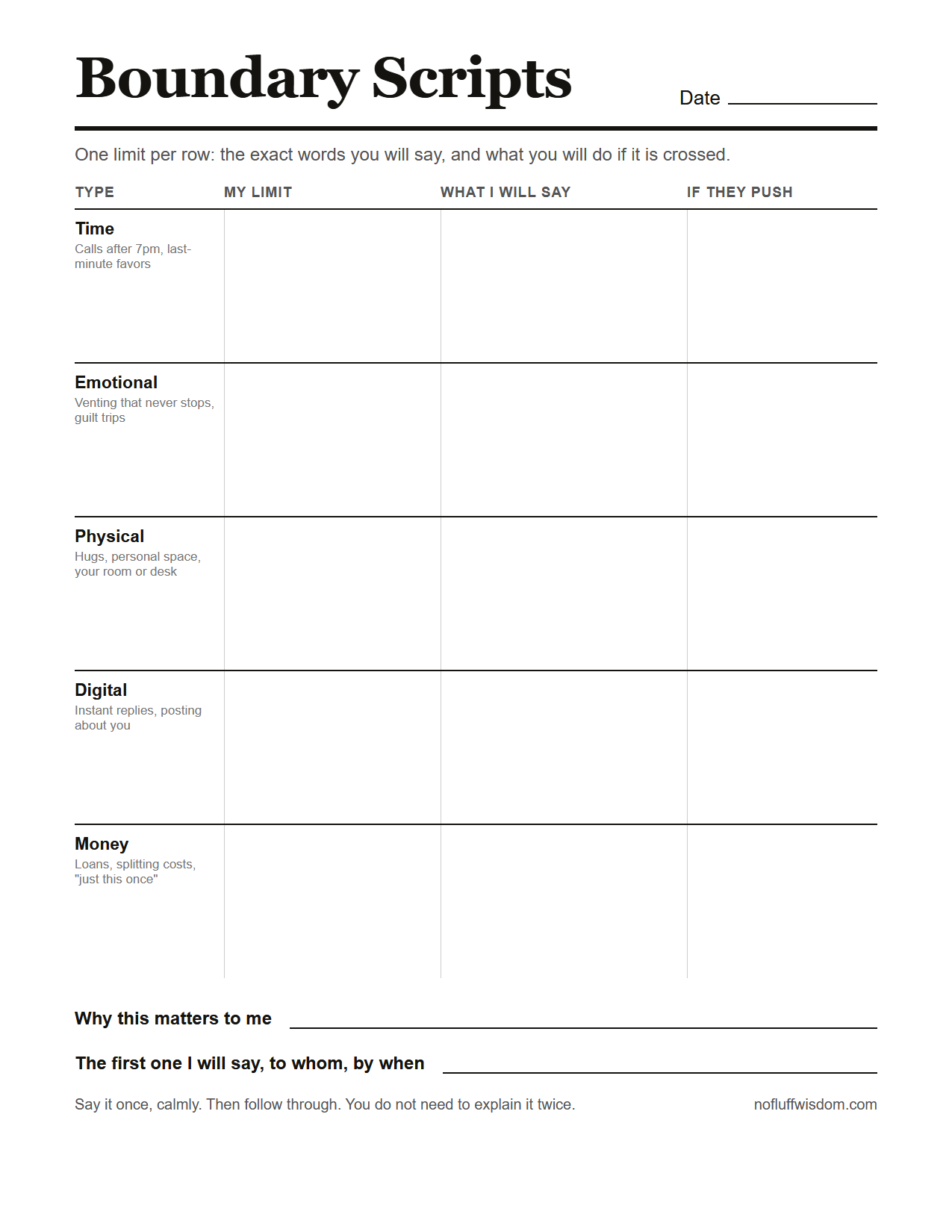
Free printable boundary scripts worksheet. Tap the button below to open it full size, then save or print.
Boundary scripts for common situations
These are starting points. Change the words until they sound like you.
With a partner: "I need an hour to myself after work before we talk about the day. Then I'm all yours."
With a parent: "I'm not going to discuss my weight. If it comes up, I'll change the subject, and if it keeps coming up, I'll head home early."
With a friend: "I can't lend money anymore. It's not about you. I've made it a rule for myself."
With a coworker or boss: "I can take that on if the report moves to Friday. Which should come first?" For more work replies, see how to stop people pleasing.
When they push back: "I hear you. My answer is still no." Then stop talking. Repeating the same sentence calmly works better than finding new reasons.
What to do when someone keeps crossing the line
Pushback is normal at first, especially from people who benefited from you having no limits. Expect it and don't read it as proof you were wrong.
If the same person crosses the same line again and again, act on your consequence without a new speech: leave, hang up, stop lending, see them less. How people respond to a clear no tells you a lot, and taking your no the first time is one of the signs someone respects you.
If you feel unsafe with someone, a boundary conversation isn't the first step. Talk to someone you trust or a local support service first.
Setting limits is much easier when your days already have a shape you're protecting. The Execution Bundle gives you both NoFluffWisdom books: 7 Steps to Change Your Life for the 7 daily habits worth guarding, with a daily tracker, and The 90-Day Discipline Blueprint for 12 guided weeks with a printable tracker. 25% off with code 25off.
Questions people ask
What are healthy boundaries in a relationship?
Limits both people can state and respect: time alone, time with friends, how you handle money, what's private and how you argue. Healthy boundaries are said openly and can be talked about.
What's the difference between a boundary and an ultimatum?
A boundary says what you'll do. An ultimatum tries to control what the other person does, usually under threat. "I'll leave if there's shouting" is a boundary. "Stop shouting or we're done" is closer to an ultimatum.
How do I set boundaries without feeling guilty?
Expect the guilt and act anyway. Guilt after a boundary usually means you're doing something new, not something wrong. It fades as the new pattern becomes normal.
How do I set boundaries with family?
Pick the one topic or habit that costs you most, state a limit before the next visit and plan your exit. With family, consistency matters more than the perfect wording.
Can boundaries be too rigid?
Yes. If your limits shut out every request and every person, they've become walls. Good boundaries protect what matters and still leave room for people.
Start with one sentence
You don't need to fix every relationship this week. You need one clear limit you say out loud and keep.
That's the bundle: 7 Steps to Change Your Life for the direction, The 90-Day Discipline Blueprint for the follow-through.
25% off with code 25off.
Fill in one row of the script sheet today and say that sentence before the week is out.
The NoFluffWisdom team