

How to Start a Journal: The 3-Line Method + Free Printable
To start a journal, pick any notebook or notes app, choose a time right after something you already do every day, and write three lines: what happened, what's on your mind, and one thing for tomorrow. Don't reread for seven days. Short entries you keep writing beat long ones you quit, so start small on purpose.
Below: the 3-line method, a sample first entry, what to do when you miss a day, and a free printable for your first week.
Night one, you wrote a page and a half in a nice new notebook. Night two, a page. Night three, you were tired, and two short lines felt like a waste of a notebook that nice. So you skipped. The rest of the pages are still blank.
You didn't quit because journaling doesn't work for you. You quit because every entry had to be worth reading.
Why do journals get dropped in the first week?
Because the bar keeps rising.
A long first entry sets the standard. Now every night has to match it: deep, honest, well written. On a normal Tuesday, nothing deep happened, so there's nothing "worth" writing. You skip, then feel bad about skipping, then avoid the notebook.
The fix is a bar so low you can clear it on your worst night.
What do you need to start a journal?
Something to write in and a time to write. That's it.
Option | Good for | Watch out for |
|---|---|---|
Any paper notebook | Writing by hand, no screen at night | Leave it where you'll see it |
Notes app on your phone | Always with you, fast | Notifications pulling you away |
A journaling app | Reminders, search, photos | Spending the first week setting it up |
Don't buy anything to start. If the habit sticks for a month, then get the notebook you like.
The 3-line journal
One line each. That's the whole entry.
1. What happened today? Facts only. "Long meeting, finished the report."
2. What's on my mind? The thing you keep thinking about, worrying about or avoiding. This is where the noise goes: out of your head and onto the page. More on that in your mind wasn't built to carry this much.
3. What's one thing for tomorrow? A specific action, not a goal. "Email Sam before 10", not "be more organized".
Three rules keep it going:
Same anchor every day. Write right after something you already do: brushing your teeth, plugging in your phone, closing the laptop. "Sometime tonight" never comes.
Use what you have. Any option from the table above works.
Don't reread for 7 days. Reading too early turns it into judging ("that's a boring entry"). On day 7, write your three lines, then read the whole week once and circle anything that shows up twice. It's the same 7-day test from how to use one self-help idea for 7 days.
Free printable: your first week of journaling
One page for your first seven days: a box to set your anchor, three labeled lines per day, and space on day 7 for what showed up twice. Tick each day as you go.
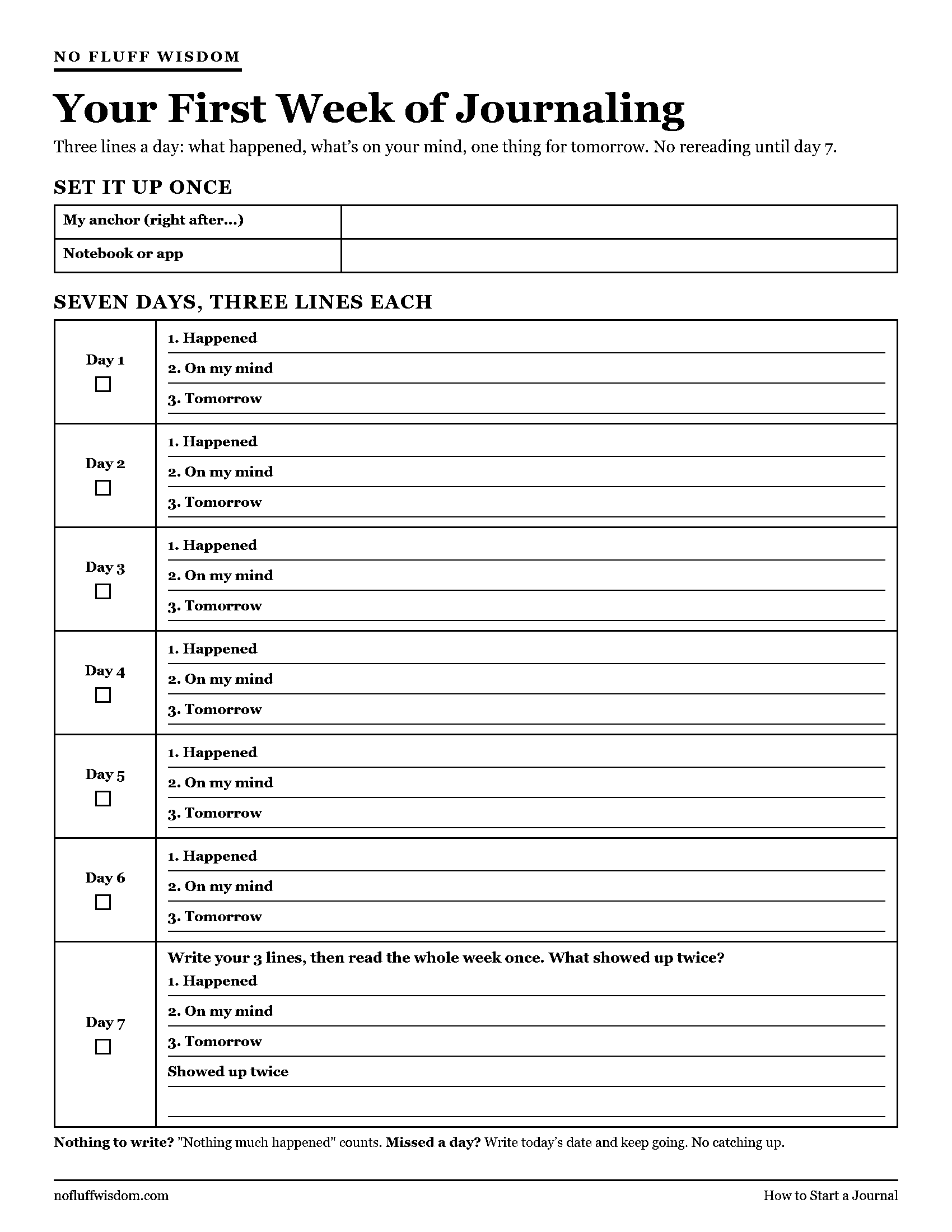
Right-click (or long-press) the image to save it, then print it on US Letter or A4 and choose "fit to page".
Text version:
Set up once: my anchor (right after ___), notebook or app.
Days 1 to 6: 1. Happened. 2. On my mind. 3. Tomorrow.
Day 7: write your three lines, then read the whole week once. What showed up twice?
Nothing to write? "Nothing much happened" counts. Missed a day? Write today's date and keep going.
Three lines a night is one habit. 7 Steps to Change Your Life has journaling as one of its 7 habits, plus a daily tracker and a simple start: pick 2 habits, run them for 7 days. It's in The Execution Bundle with The 90-Day Discipline Blueprint, which keeps them going for 12 weeks. 25% off with code 25off.
What should you write in your first journal entry?
The same three lines as every other night. Don't make the first one special. A big first entry is exactly what makes night three feel like a letdown.
Hypothetical first entry:
Started this journal. Work was busy, gym after.
Keep thinking about whether to say yes to the weekend trip.
Reply to Jo about the trip by lunch.
That's a complete entry. It took under two minutes.
What a week of it looks like
A hypothetical week, from a different first night. Day 1:
Long meeting, finished the report.
Still annoyed about the budget comment.
Email Sam about the deadline before 10.
Days 2 to 6 look about the same. Some are boring. One just says "Tired, quiet day."
On day 7, the reread takes 2 minutes. "Budget" is on line 2 four times. That's not a feeling anymore, it's a pattern. So the next line 3 is: "Book 15 minutes with my manager about the budget."
No single entry was deep. The week was useful.
When you have nothing to write
Write "Nothing much happened" on line 1 and keep going.
Line 2 usually has something, even if it's "nothing on my mind, just tired". Line 3 still needs one action, even a small one: "Go to bed by 11."
A boring entry you kept beats a great one you skipped. The reread only works if the days are there.
If the anchor keeps slipping, move it earlier. Right before bed is when you're most tired. Try right after dinner or right after you close the laptop instead.
What if you miss a day?
Write today's date and today's three lines. Don't go back and fill in the missed day, and don't write two entries to catch up. Catching up turns a two-minute habit into a chore, and chores get skipped.
One missed day is normal. Two in a row is where habits quietly end, so the rule is simple: never miss twice.
What comes after the first week?
Keep the three lines for at least a month. Once they feel automatic, you can add a prompt on nights you want to write more. Our journal prompts list has a 30-day prompt calendar for those nights, and our gratitude journal prompts come with a 31-day sheet if you'd like to try gratitude. Keep your three lines as the daily habit; the prompt is extra.
FAQ: how to start a journal
How do I start a journal as a beginner?
Pick any notebook or notes app, choose a daily anchor (right after brushing your teeth, for example), and write three lines: what happened, what's on your mind, one thing for tomorrow. Reread once after seven days.
What should I write in my first journal entry?
The same three lines you'll write every day. Keep it short on purpose, so the first entry doesn't set a bar you can't keep up.
Is it better to journal in the morning or at night?
Whichever you can tie to something you already do every day. Night works well for "what happened". Morning works if your evenings are unpredictable. Pick one and keep it the same.
How long should a journal entry be?
Three lines is enough to start. You can always write more on a night you want to, but the daily minimum should be small enough for your worst day.
Should I journal on paper or in an app?
Use what you already have. Paper keeps you off your phone at night; an app is always with you. The tool matters much less than writing at the same time each day.
If the journal sticks and you want the next habit to stick too, the bundle has both books: 7 Steps to pick it, the 90-Day Blueprint to keep it going past week one. 25% off with code 25off.
Tonight, pick your anchor and write three lines, in a notebook or your notes app. Then you're done for the night.
The NoFluffWisdom team