

SMART Goals Examples: 36 Examples + Free SMART Goal Template
A SMART goal is Specific, Measurable, Achievable, Relevant and Time-bound. In practice, that means it names the action, a number, and a date: "Walk 20 minutes after dinner 5 days a week until March 31" instead of "get fit". The SMART goals examples below show 36 vague goals rewritten that way, plus a free template to write your own.
Most goal lists stop at the finished goal. This page shows the before and after, because that's the part you'll actually do yourself: take a fuzzy wish and make it something you can check off.
What does SMART stand for?
Each letter is a test the goal has to pass.
Letter | Means | The question it asks | Fails | Passes |
|---|---|---|---|---|
S | Specific | What exactly will I do? | "Read more" | "Read one nonfiction book" |
M | Measurable | What number tells me it's done? | "Read a lot" | "20 pages a day" |
A | Achievable | Does it fit my real week? | "A book a day" | "20 pages before bed" |
R | Relevant | Why does this matter now? | "Because people say I should" | "I want to learn about money" |
T | Time-bound | By when? | "Someday" | "By February 28" |
The letter people skip is A. A goal can be specific, measurable and dated and still be useless if it needs time you don't have. The quickest check: what will you stop doing to make room for it? If the answer is "nothing", the goal probably won't fit.
How do you write a SMART goal?
Use one sentence with three blanks:
I will [action + number] by [date], and I'll know it's working when [check-in sign].
Example: "I will walk 20 minutes after dinner 5 days a week through March 31, and I'll know it's working when I've logged 35 walks by the end of February."
Then add two lines most templates leave out:
The first step, with a day and time. "Monday 7:15 pm, shoes by the door."
An if-then plan for the most likely problem. "If it's raining, then I'll walk the stairs at home for 15 minutes."
The first step gets you moving this week. The if-then plan covers the day it goes wrong.
SMART goals examples by life area
Each row starts with the goal most people write, then the SMART version. Change the numbers and dates to fit your life. The dates assume you're starting in January; move them to match your start.
Health
Vague goal | SMART goal |
|---|---|
Drink more water | Drink a glass of water with each meal every day for the next 30 days, tracked with a tick on the fridge calendar |
Eat healthier | Have vegetables with lunch and dinner 5 days a week through the end of February |
Sleep better | Be in bed by 11 pm on weeknights for 4 weeks, phone charging outside the bedroom |
Cut down on sugar | Swap my afternoon soda for water or tea on weekdays for 6 weeks |
Fitness
Vague goal | SMART goal |
|---|---|
Get fit | Walk 20 minutes after dinner 5 days a week through March 31 |
Get stronger | Do a 25-minute strength workout every Monday, Wednesday and Friday for 8 weeks |
Run a 5K | Follow a beginner run-walk plan 3 times a week and finish a 5K by May 1 |
Be more flexible | Stretch for 10 minutes after waking up 5 days a week for 30 days |
Money
Vague goal | SMART goal |
|---|---|
Save more | Move 10% of each paycheck into a separate savings account on payday, through June 30 |
Stop overspending | Write down every purchase in a notes app for 30 days, then pick one category to cut |
Pay off debt | Set an extra payment amount today, pay it toward my smallest debt on the 1st of every month, and clear that debt by December 31 |
Learn about money | Read one personal finance book, 20 pages a night, by February 28 |
Work and career
Vague goal | SMART goal |
|---|---|
Be more productive | Block the first 90 minutes of each workday for one priority task, no email, for 4 weeks |
Get promoted | Ask my manager by January 15 what a promotion needs, then agree 3 targets to review by June 30 |
Improve my skills | Finish an online course in spreadsheets, 2 lessons a week, by March 15 |
Network more | Message one former colleague or contact every Friday for 10 weeks |
Leadership and managing a team
Vague goal | SMART goal |
|---|---|
Be a better leader | Hold a 20-minute one-on-one with each team member every second week through June 30 |
Give more feedback | Give each person on my team one specific piece of feedback every Friday for 8 weeks |
Delegate more | Hand off one recurring task to a team member each month, with a written checklist, through April |
Run better meetings | Send an agenda 24 hours before every meeting I run and end each one with owners and dates, for 6 weeks |
School and students
Vague goal | SMART goal |
|---|---|
Get better grades | Raise my math grade by one letter by the end of term by doing 30 minutes of practice problems 4 days a week |
Study more | Study in two 25-minute blocks every weekday at 4 pm, phone in another room, for the whole term |
Stop cramming | Review each class's notes for 10 minutes the same day, starting this week, until finals |
Read more | Read 15 pages of a book of my choice every night before bed for 6 weeks |
Personal growth
Vague goal | SMART goal |
|---|---|
Start journaling | Write three lines in a notebook right after brushing my teeth every night for 30 days |
Learn a language | Do 15 minutes of Spanish practice every morning and hold a 5-minute conversation by June 30 |
Spend less time on my phone | Keep daily screen time under 2 hours on weekdays for 4 weeks, checked every Sunday |
Be more confident | Speak up at least once in every team meeting for 6 weeks |
Relationships
Vague goal | SMART goal |
|---|---|
Spend more time with family | Have dinner at the table, phones away, 4 nights a week through March |
Keep in touch with friends | Call or message one friend every Sunday afternoon for 3 months |
Be a better partner | Plan one date night every second Saturday through April |
Argue less | Take a 20-minute break before replying in any heated argument, every time, for 8 weeks |
Home
Vague goal | SMART goal |
|---|---|
Declutter the house | Clear one drawer or shelf every Saturday morning for 10 weeks |
Keep the house tidy | Do a 10-minute reset of the kitchen and living room every night at 9 pm for 30 days |
Cook more | Cook dinner at home 4 nights a week, with a meal plan written every Sunday, for 6 weeks |
Fix up the house | Finish the three small repairs on my list, one per weekend, by February 15 |
Free printable: SMART goal template
The template takes one goal through all five letters, then turns it into the one-sentence version. It also has room for your first three steps, five check-ins and an if-then plan.
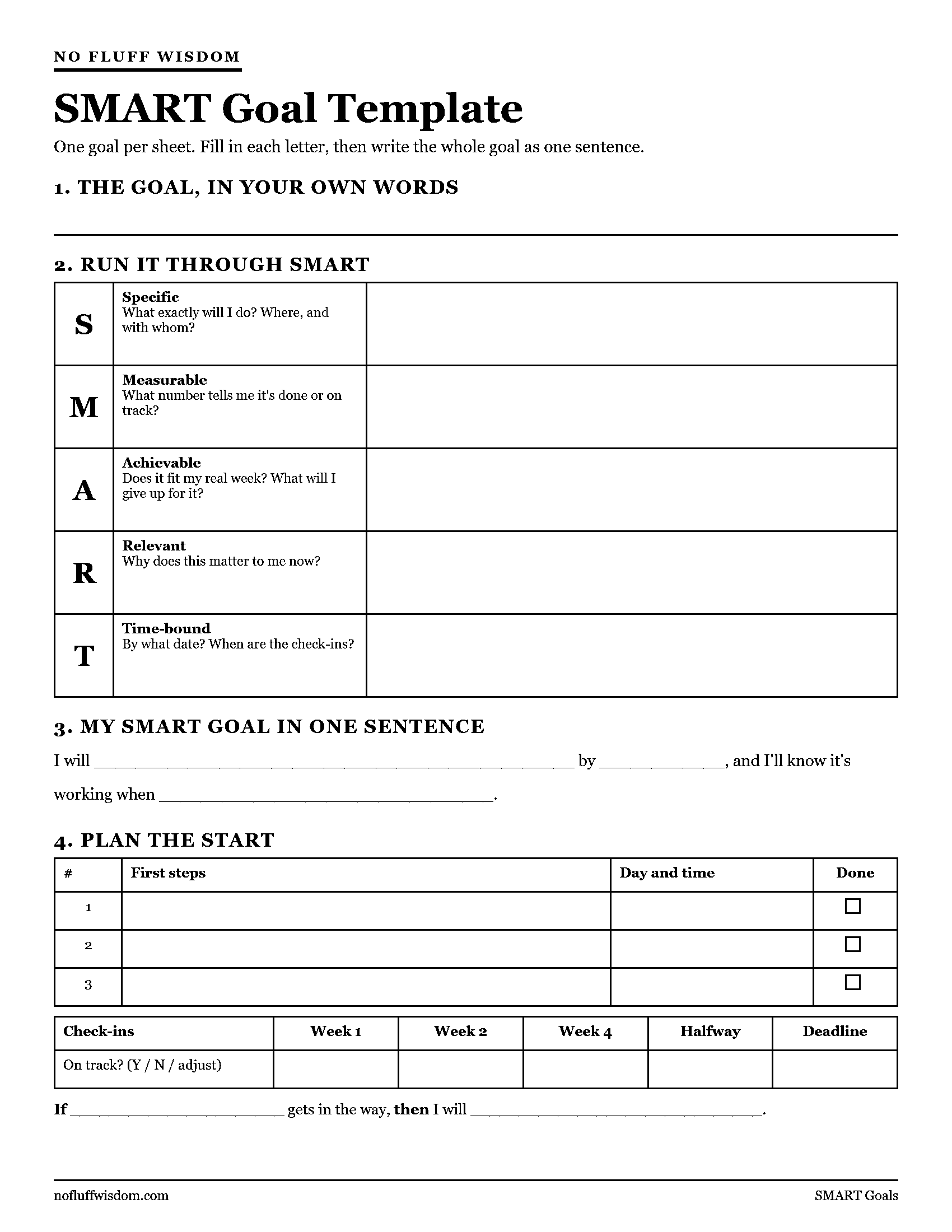
Right-click (or long-press) the image to save it, then print it on US Letter or A4 and choose "fit to page".
Text version (if you'd rather copy it into a notebook):
The goal, in your own words.
S: What exactly will I do? Where, and with whom?
M: What number tells me it's done or on track?
A: Does it fit my real week? What will I give up for it?
R: Why does this matter to me now?
T: By what date? When are the check-ins?
My SMART goal in one sentence: I will ___ by ___, and I'll know it's working when ___.
First 3 steps, each with a day and time.
Check-ins: week 1, week 2, week 4, halfway, deadline. On track, off track, or adjust?
If ___ gets in the way, then I will ___.
A template gets one goal clear. Keeping it going for months is a different problem, and that's what The Execution Bundle covers: both NoFluffWisdom books together. 7 Steps to Change Your Life covers seven habits worth building first, with a daily tracker and a simple start: pick 2, run them for 7 days. The 90-Day Discipline Blueprint gives you 12 guided weeks, a printable 90-Day Tracker and a Restart Plan for the weeks that go sideways. 25% off with code 25off.
A worked example: one goal, start to finish
Hypothetical example. Sam wants to "save money this year".
S: Save for an emergency fund, in a separate account.
M: 10% of each paycheck.
A: Sam checks last month's spending. Takeout is the easiest cut, so 10% fits if takeout drops from 3 nights to 1.
R: Sam's car needed a repair last year and it went on a credit card. Sam doesn't want that again.
T: Every payday through June 30, with a check on the last Friday of each month.
Sam's SMART goal: "I will move 10% of each paycheck into a separate savings account on payday through June 30, and I'll know it's working when the balance has gone up every month."
First step: Open the savings account Saturday morning and set up an automatic transfer for payday.
If-then plan: If an unexpected bill comes up, then I'll pause the transfer for one paycheck only, and write down why.
Notice what changed. "Save money" had nothing to check. The SMART version gives Sam something to do on payday and a way to see, each month, whether it's working.
Why do SMART goals still fail?
SMART fixes vague goals. It doesn't fix these:
Too many at once. Five SMART goals in January is five things competing for the same evenings. Start with one, two at most.
No check-in. A deadline in June is easy to ignore in February. Put the check-in dates in your calendar today.
The goal is the outcome, not the action. "Lose 10 pounds" depends on things you can't fully control. "Walk 20 minutes 5 days a week" is fully yours. Track the action; the outcome follows or it doesn't, and you adjust.
One missed day ends it. It shouldn't. Miss once, get back the next day. The never miss twice rule is built for exactly that.
If you're past the writing stage and stuck on keeping going, how to set goals that stick walks through the whole process with a goal setting worksheet. And if your SMART goal is a daily action, put it on a habit tracker so the misses show up early.
FAQ: SMART goals examples
What is an example of a SMART goal?
"I will walk 20 minutes after dinner 5 days a week through March 31." It says what (walk 20 minutes), how much (5 days a week), and by when (March 31), and it fits a normal week.
What are the 5 rules of SMART goals?
The goal must be Specific (a clear action), Measurable (a number), Achievable (fits your real time and energy), Relevant (matters to you now) and Time-bound (has a deadline and check-ins).
What is the formula for a SMART goal?
I will [action + number] by [date], and I'll know it's working when [check-in sign]. Add a first step with a day and time, and an if-then plan for the most likely problem.
What is a measurable goal?
One where a number tells you whether you did it: minutes, days per week, pages, a percentage of each paycheck. "Read more" isn't measurable. "20 pages a night" is.
Are SMART goals good for New Year's resolutions?
Yes. A lot of resolutions stall because they're vague ("get healthy"). Running each one through SMART turns it into an action you can track from the first week. Our 2027 resolutions guide has ideas to start from.
One clear goal, written down, beats five in your head. If you want the 90-day version, both books are in one bundle. 25% off with code 25off.
Right now, in under 10 minutes: pick one vague goal you've been carrying around, find its closest example above, and rewrite it in the one-sentence formula. Then put the first step in your calendar with a day and time.
The NoFluffWisdom team