
How to build good habits that last
Short answer: To build a good habit, pick one, shrink it until it takes two minutes or less, and tie it to something you already do every day. Set up your space so it's easy to start, tick it off each time, and decide in advance what the bad-day version is. Expect it to feel automatic after weeks or months, not days.
What makes a habit stick
A habit is something you do with little thought because the same situation keeps setting it off. Repeating it in the same place, at the same point in your day, is what builds it. That's why "after my morning coffee" works far better than "sometime today."
Three things matter most: a clear cue, an action small enough that you'll do it on a bad day, and a quick sense that it counted. Motivation helps you start. The setup is what keeps it going in week three, when the excitement is gone.
How to build good habits in 7 steps
Choose one habit. Not a new morning, a new diet and a new gym plan at once. One habit you'd be glad to still have in a year.
Make it tiny. Pick the version you'd do on your worst day. "Put on running shoes and step outside," not "run 5k." You can do more, but the tiny version is what counts.
Anchor it to something you already do. "After I pour my coffee, I write one line in my notebook." This is often called habit stacking, and many people find it the easiest way to remember.
Set up your space. Lay out what you need the night before. Remove one step: the book on your pillow, the water bottle on your desk, the gym bag by the door.
Track it where you'll see it. A tick on a paper calendar is enough. Seeing a run of ticks is its own small reward.
Make it feel finished. Take a second to notice you did it. Pair it with something you enjoy, like a podcast you only play on your walk.
Plan for misses. Write down your bad-day version now. A popular rule is "never miss twice": one missed day is normal, two in a row is the start of quitting.
Once the tiny version feels automatic, grow it slowly. Two pages become five. A 5-minute walk becomes 15.
How long does it take to build a habit?
Longer than most people expect. In a University College London study, 96 adults each picked one small daily behavior. It took a median of 66 days to feel automatic, with a range of 18 to 254 days. Simple actions, like drinking a glass of water, tended to get there faster than harder ones, like a daily set of sit-ups.
The popular 21 days isn't backed by research. We explain where that number came from, and what the first weeks of change usually feel like, in our guide on how to break a bad habit.
Good habits list: 10 to choose from
Most lists give you 50 to 100 ideas and no way to choose. Here are 10 with a tiny version and an honest note on why each is worth it. Pick the one that would make the biggest difference to your week, not the one that sounds most impressive.
Habit (tiny version) | Time | Why it's worth it |
|---|---|---|
Same wake time, 7 days a week | 0 min | Regular sleep times are one of the best-supported sleep habits. |
A walk after lunch | 10 min | Regular movement has strong evidence for health and mood. |
Fruit or vegetables with one meal | 2 min | Simple, and one of the habits in the UCL study. |
Phone out of the bedroom | 1 min | Removes the late-night scroll at the source. |
Plan tomorrow on one page | 5 min | You start the day knowing the first task. |
One hard task before email | 25 min | Your best hour goes to what matters. |
Read two pages before bed | 5 min | An easy swap for the screen at night. |
Tidy one surface | 5 min | Small resets stop mess from piling up. |
Message one friend a week | 3 min | Strong social ties are linked to better health. |
Automatic savings on payday | 10 min once | Set it up once and it runs without willpower. |
Free printable: tiny habit plan
Print the plan below or copy it into your notes. Write your habit, the tiny version, the anchor ("after I..."), your setup, your reward and your bad-day version. Then tick one box each day for 30 days. Missed boxes are fine. Two blank boxes in a row are your signal to shrink the habit.
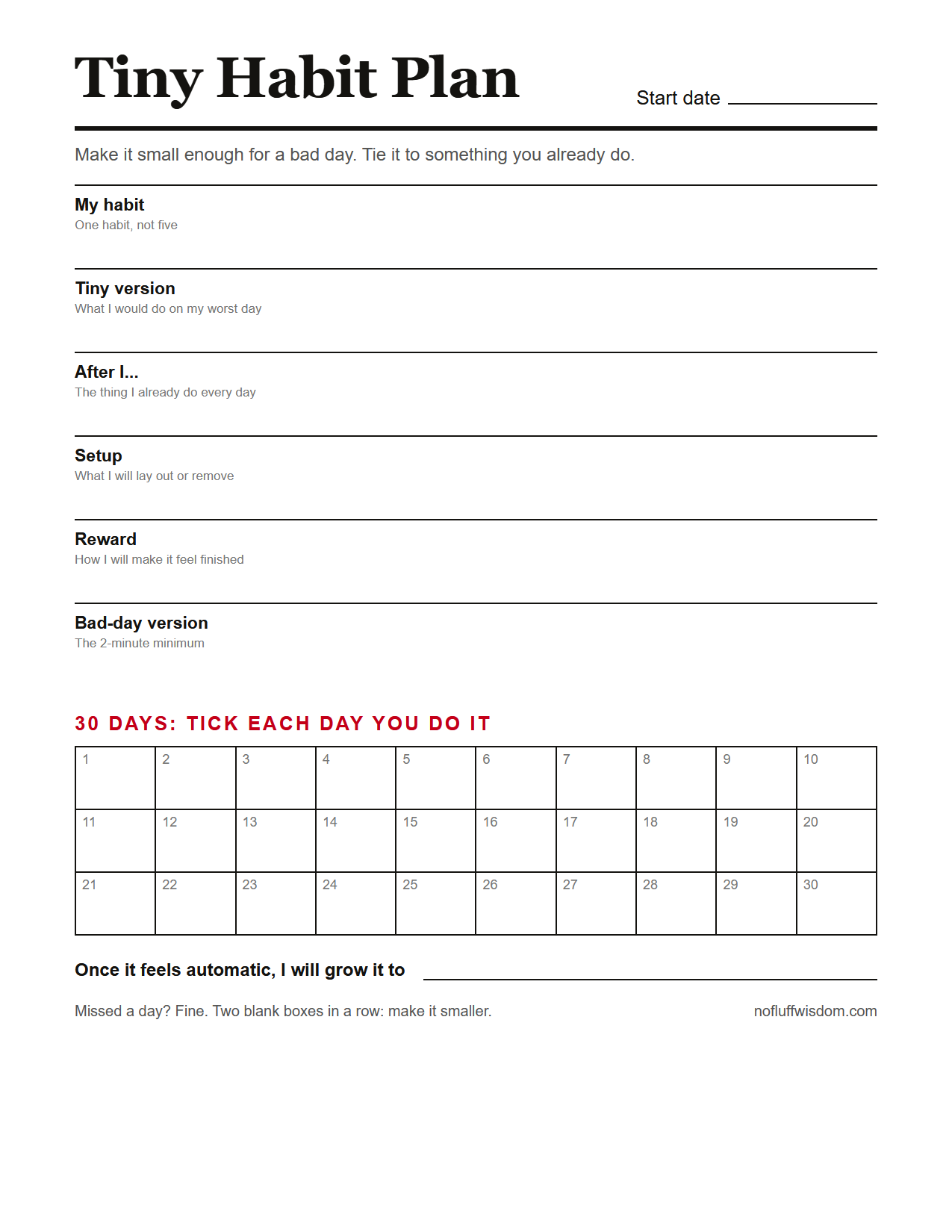
Free printable tiny habit plan. Tap the button below to open it full size, then save or print.
A worked example (hypothetical)
Goal: exercise more.
Habit: a short walk on workdays. Tiny version: shoes on, out the door, to the end of the street.
Anchor: "After I close my laptop for lunch, I put my shoes on." Setup: shoes by the desk, not in the closet.
Reward: one podcast episode saved only for the walk. Bad-day version: two minutes outside, even in the rain.
A month in, the walk is 15 minutes most days, because starting was never the hard part. For a deeper take on this method, see our Atomic Habits summary.
If you want the habits picked for you, The Execution Bundle gives you both NoFluffWisdom books: 7 Steps to Change Your Life for 7 core habits with a daily tracker and a Reset Protocol, and The 90-Day Discipline Blueprint for 12 guided weeks, a printable 90-Day Tracker and a Restart Plan. 25% off with code 25off.
Questions people ask
How many habits can I build at once?
Start with one. Add a second once the first takes almost no thought. Trying five at once usually means dropping all five in the same bad week.
What is habit stacking?
Linking a new habit to one you already do: "after I brush my teeth, I do 10 squats." The old habit becomes the reminder.
Do I have to do it every day?
Daily is easiest because it builds the link fastest, but a habit can be weekly too. What matters is the same cue each time.
What should I do if I keep failing at a new habit?
Make it smaller and check the anchor. Most failed habits were too big for a bad day, or tied to a moment that doesn't happen reliably.
What is the single most effective technique?
If you only change one thing, make the habit so small it's hard to skip, and do it at the same point in your day.
Start smaller than feels useful
The habit that lasts is the one you can do on your worst day. Build that first. Growing it is the easy part.
That's the bundle: 7 Steps to Change Your Life for the direction, The 90-Day Discipline Blueprint for the follow-through.
25% off with code 25off.
Print the tiny habit plan and fill in one line: "After I ___, I will ___."
The NoFluffWisdom team