
How to break a bad habit, step by step
Short answer: To break a bad habit, find what sets it off, decide what you'll do instead when that happens, and make the old habit harder to reach. You rarely delete a habit. You replace it with something that meets the same need. Expect it to take weeks, not days, and plan for slips so one bad day doesn't end the attempt.
Why bad habits are so hard to stop
A habit is a shortcut. Something sets it off (a time, a place, a feeling, a person), you do the thing, and you get a small payoff: relief, comfort, a break, something to do with your hands. After enough repeats, the cue starts the action before you've decided anything.
That's why willpower on its own fades. You're arguing with an automatic loop every single time. It works better to change the loop itself: the cue, the action, or how easy the action is to start.
How to break a bad habit in 6 steps
Pick one habit and name it as an action. "Scroll my phone in bed," not "stop wasting time." If you can't picture yourself doing it, it's too vague to change.
Track it for 3 days before you change anything. Each time it happens, note the time, the place, who you were with, how you felt and how strong the urge was from 1 to 10. Most habits cluster around two or three triggers, and you'll usually spot them by day three.
Name the need it meets. Ask what the habit gives you. Scrolling in bed might be how you wind down. A 3pm snack might be boredom, or real hunger. The replacement has to meet the same need, or the old habit comes back.
Write an if-then plan. "If I get into bed, then I put my phone on the charger across the room and read two pages." Psychologists call these implementation intentions, and they're one of the better-tested tools for following through on a change.
Add friction to the old habit. Make it take more steps: log out, move it to another room, stop buying it, delete the shortcut. Then put the replacement within easy reach.
Plan the slip before it happens. Decide now: "If I slip, I restart at the next trigger, not next Monday." One miss doesn't undo your progress. Quitting after one miss does.
How long does it take to break a habit?
No study gives a reliable number for breaking a habit. The famous 21 days traces back to a 1960 self-help book, Maxwell Maltz's Psycho-Cybernetics, where he described patients adjusting after surgery. It's a popular idea, not a research finding.
The closest evidence is about forming new habits. In a University College London study, 96 adults each picked one small daily behavior, like eating fruit with lunch. It took a median of 66 days to feel automatic, with a range of 18 to 254 days. Simple actions got there faster than harder ones.
So plan in weeks and months. This is a rough guide to what it often feels like, not a timeline anyone can promise:
Stage | What it often feels like | What to do |
|---|---|---|
Weeks 1 to 2 | Strong urges. You notice the habit everywhere. | Follow the if-then plan, even when it feels clumsy. |
Weeks 3 to 8 | Weaker urges, but surprise slips on stressful days. | Restart at the next trigger. Change the replacement if it isn't meeting the need. |
Week 9 and after | The new action starts to feel normal. | Keep the friction in place. Old triggers can still catch you on bad days. |
Free printable: bad habit swap plan
Print the sheet below or copy it into your notes. Use the top half for three days of trigger tracking. Then fill in the swap plan: the habit, the need it meets, your replacement, the friction you'll add, your if-then sentence and what you'll do after a slip.
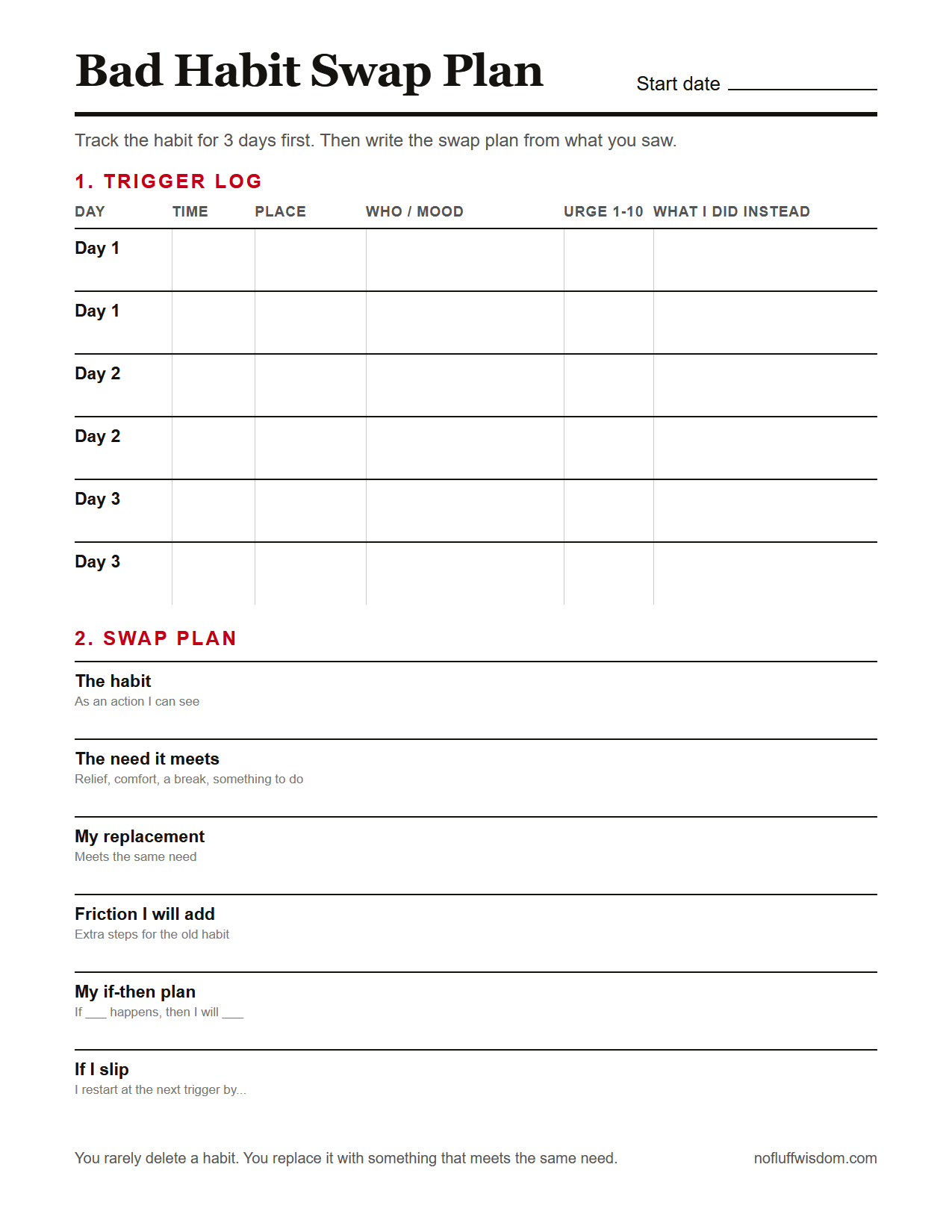
Free printable bad habit swap plan. Tap the button below to open it full size, then save or print.
A worked example (hypothetical)
The habit: scrolling the phone in bed for an hour most nights.
What the trigger log shows: it starts after 10:30pm, in bed, when tired but restless. Urge around 8 out of 10.
The need: switching off without having to think.
The replacement: a paper book or a podcast with the screen face down.
The friction: the charger moves to the dresser, and the phone goes there at 10:15pm.
The if-then plan: "If I'm brushing my teeth, then the phone goes on the charger."
The slip plan: "If I end up scrolling anyway, I put it down at the next ad and try again tomorrow at 10:15."
Breaking a habit leaves a gap, and a good habit is the best thing to put there. Our guide on how to build good habits covers that half. To keep an eye on the new one, pick from these habits to track.
When a habit needs more than a plan
Some habits are more than habits. If it involves alcohol, drugs, gambling or self-harm, or it keeps going despite serious harm to your health, money or relationships, talk to a doctor or a local support service. Stopping some substances suddenly can be risky, so get advice first. The steps above can sit alongside that help, not replace it.
A swap plan is easier to keep inside a day that already has some structure. The Execution Bundle gives you both NoFluffWisdom books: 7 Steps to Change Your Life for 7 core habits, a daily tracker and a Reset Protocol for low-energy or distracted days, and The 90-Day Discipline Blueprint for 12 guided weeks with a printable 90-Day Tracker. 25% off with code 25off.
Questions people ask
Is the 21-day rule true?
No. It comes from a 1960s self-help book, not a study. The best evidence on new habits found a median of 66 days, and a very wide range between people.
What is the fastest way to break a bad habit?
Change your surroundings so the habit is harder to start, and have a replacement ready for the trigger. There's no trick that skips the weeks of practice, but friction makes those weeks much easier.
Can I break more than one habit at once?
You can, but each one takes attention. Start with the habit that costs you most, and add the next once the first takes less effort.
What if I keep slipping?
Look at your trigger log. Repeated slips usually mean the replacement isn't meeting the real need, or the old habit is still too easy to reach. Change one of those, not your whole plan.
Should I quit cold turkey or cut down slowly?
For everyday habits like snacking or scrolling, either can work. Pick the one you'll actually stick to. For alcohol, drugs or medication, ask a doctor first.
Start with three days of noticing
You don't need to stop today. You need to know when, where and why it happens. Then one if-then sentence does the heavy lifting.
That's the bundle: 7 Steps to Change Your Life for the direction, The 90-Day Discipline Blueprint for the follow-through.
25% off with code 25off.
Print the swap plan and start the trigger log tonight.
The NoFluffWisdom team