
How to find motivation when you don't feel like doing anything
Short answer: To find motivation, stop waiting to feel ready and work out why you're stuck: tired, unclear, afraid, bored or low. Fix that one cause, then shrink the task to a 2-minute first step and do it now. Motivation often shows up after you start, not before. If you've felt flat for weeks, that's worth talking to a doctor about.
Why you have no motivation
"No motivation" isn't one problem. It's a feeling that several different problems share, and each one needs a different fix. Pushing harder works for some of them and makes others worse.
Before you try any tip, spend one minute on the question: what's really going on? The table below covers the five most common causes.
If it feels like... | It's probably | Try this first |
|---|---|---|
"I can't keep my eyes open." | Tired | Rest, food, water or a walk. Then a smaller task. |
"I don't know where to start." | Unclear | Write the very next physical action. |
"What if it's bad?" | Afraid | Make a rough first version nobody will see. |
"Why bother? It's pointless." | Bored or disconnected | Name who or what it's for, or change how you do it. |
"I don't care about anything lately." | Low mood | Be gentle, keep tasks tiny and talk to someone. |
How to get motivated in the next 10 minutes
Most advice gives you 17 tips and no order. Here's an order.
Minute 1: name the cause. Pick one row from the table. Be honest. Tired and afraid can look the same from the inside.
Minutes 2 to 3: fix the body. Drink some water, eat something if you haven't, stand up, open a window. If you're truly exhausted, a short rest is the right call, not a failure.
Minute 4: shrink the task. Not "write the report" but "open the file and type the title." Not "clean the kitchen" but "put five things away." The first step should feel almost too small to count.
Minute 5: remove one distraction. Phone in another room, one tab open, notifications off.
Minutes 6 to 10: start the timer. Do the tiny step for 5 minutes. When the timer ends, you're allowed to stop. Often you won't want to.
That last step is the main idea. Starting small often brings the drive with it, because progress feels good and the task stops looking so big. You don't need to feel motivated to begin. You need a start small enough that the feeling doesn't matter.
Free printable: motivation self-check
Print the sheet below or copy it into your notes. Circle what's going on, write the task, shrink it to a 2-minute first step and set a time. At the end of the day, note what happened. After a week you'll see your pattern, and you'll know which fix to reach for first.
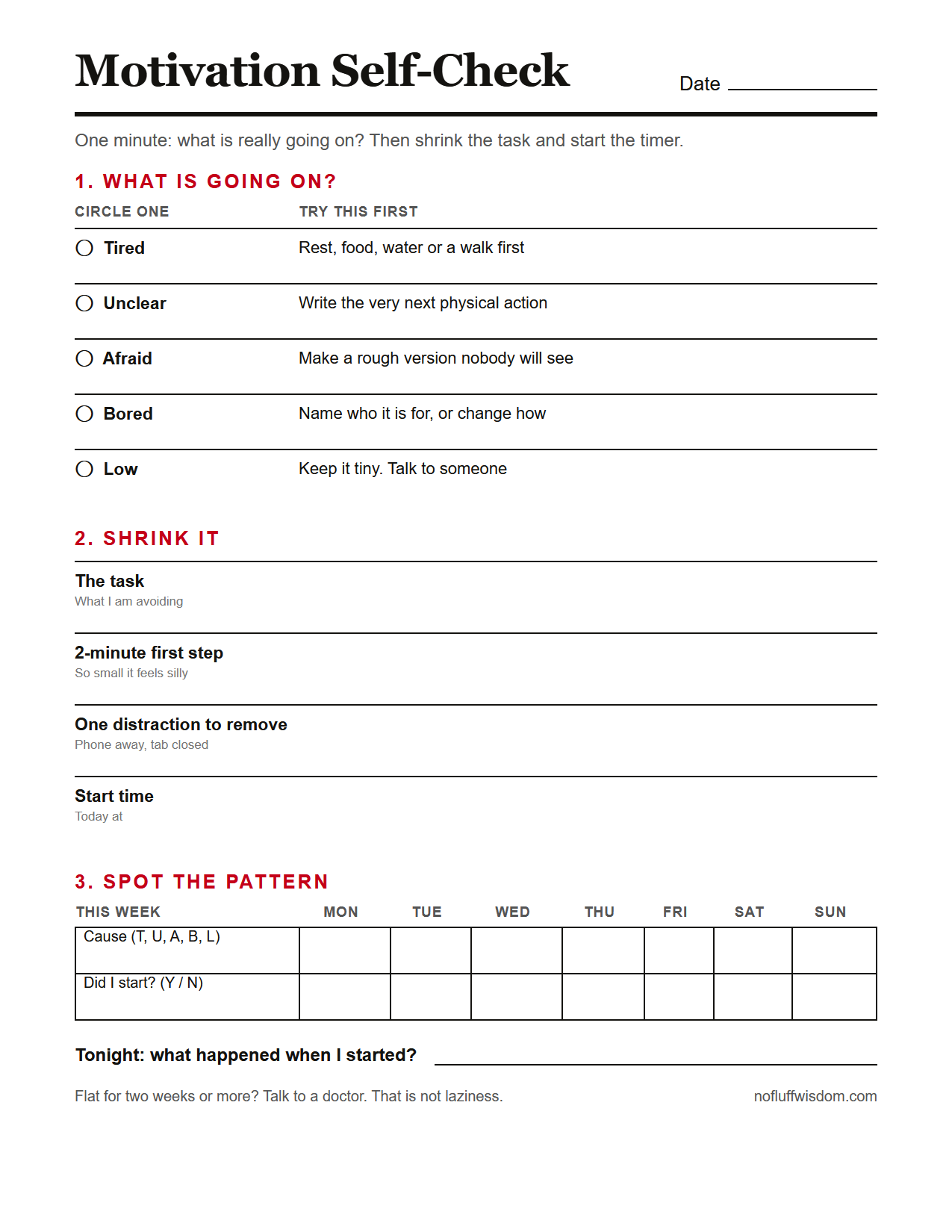
Free printable motivation self-check. Tap the button below to open it full size, then save or print.
How to stay motivated after you start
Make progress visible. Tick off steps, keep a done list or put a mark on a calendar. Seeing what you've done is one of the simplest ways to keep going.
Choose goals you actually care about. Doing something for its own sake, or because it fits what you value, tends to last longer than doing it only for a reward or to avoid trouble. If a goal feels hollow, it may be the wrong goal, or just too vague. These SMART goals examples help turn a vague wish into a clear target.
Tell someone. A friend who asks "did you do it?" on Friday is worth a lot of willpower.
Plan for the dip. Motivation is usually highest at the start and often drops after the first couple of weeks. That's normal. When it drops, keep the steps tiny rather than stopping.
Build a routine that doesn't need it. In the long run, the people who keep going rely less on how they feel and more on a set time and place. That's the difference between motivation and discipline, and why you need both.
If you'd rather follow a plan than wait for the feeling, The Execution Bundle gives you both NoFluffWisdom books: 7 Steps to Change Your Life for 7 core habits with a daily tracker, and The 90-Day Discipline Blueprint for 12 guided weeks, a printable 90-Day Tracker and a Mindset Script Collection. 25% off with code 25off.
When low motivation is something more
Losing interest in things you usually enjoy, feeling low most days, or struggling to get through the day for two weeks or more can be signs of depression or another health problem. That isn't laziness, and tips won't fix it. Please talk to a doctor or a mental health professional. If you ever feel unsafe, contact your local emergency number or a crisis line.
Questions people ask
How do I find motivation when I feel lazy?
"Lazy" is usually tired, unclear or afraid in disguise. Name which one, then start with a 2-minute step.
How do I motivate myself to do something I hate?
Make it shorter and give it an end time. "30 minutes on the tax forms, then I stop" is much easier to start than "do my taxes."
Why do I start strong and then quit?
Early excitement fades for almost everyone. Plan for it from day one: a fixed time, a tiny minimum and someone who checks in.
Can music or rewards help?
They can help you start, and that's useful. Just don't rely on them alone. Over time, a routine carries more weight than a reward.
Is lack of motivation a sign of depression?
It can be, especially with low mood or lost interest for two weeks or more. Only a professional can tell you, so it's worth asking.
Start before you feel ready
Motivation isn't something you find and then use. It's something you get back by starting small.
That's the bundle: 7 Steps to Change Your Life for the direction, The 90-Day Discipline Blueprint for the follow-through.
25% off with code 25off.
Pick one task you've been avoiding and do the 2-minute version now.
The NoFluffWisdom team