

What fear of failure is (and what it looks like)
Short answer: Fear of failure is the worry that trying and falling short will cost you something you can't afford: money, status, other people's opinion or your own sense of worth. It rarely looks like fear. It looks like procrastination, perfectionism and endless preparation. To overcome it, make the fear specific, plan for the worst realistic outcome and take one small step you could survive failing at. The worksheet below walks you through it in 15 minutes.
A very intense, persistent fear of failing is sometimes called atychiphobia. Most people don't have a phobia, though. They have a normal fear that has grown big enough to run their decisions.
Signs fear of failure is running the show
What you do | What it's protecting you from |
|---|---|
Put off starting until "the right time" | Finding out it might not work |
Polish and re-polish instead of finishing | Being judged on a finished thing |
Keep researching and taking courses | Having to try with what you know now |
Set goals so low they can't fail | Wanting something and missing it |
Make excuses before you begin | Looking like you failed with full effort |
That last one has a name: self-sabotage. If you didn't really try, a bad result doesn't count. It feels safer, and it guarantees the outcome you were afraid of.
What causes fear of failure?
Tying your worth to results. If failing at a task means you are a failure, every attempt is a test of your whole value.
Past experiences. Being criticized, mocked or punished for mistakes teaches you that mistakes are dangerous.
Perfectionism. When anything less than excellent counts as failing, almost everything does.
Vague stakes. A fear you haven't looked at closely feels bigger than one you've written down.
How to overcome fear of failure in 6 steps
Name the step you're avoiding. Not "my career," one action: "send the portfolio to three studios."
Size the worst realistic outcome. Not the catastrophe your brain offers at 2am. What would most likely happen? Usually: a no, some embarrassment, a few lost hours.
Plan to prevent it. What would make that outcome less likely? Practice once, ask one person to review it, start smaller.
Plan to repair it. If it happens anyway, what would you do next? Seeing a recovery plan on paper takes a lot of the fear out.
Count the cost of waiting. Six more months of not trying has a price too. Write it down next to the risk of trying.
Take the smallest real step, with a date. Something you could fail at and be fine. Then do the next one.
Free printable: fear of failure worksheet
Print it or copy the six prompts into your notes. Use one sheet per decision. Fill it in fast; the first honest answer is usually the useful one.
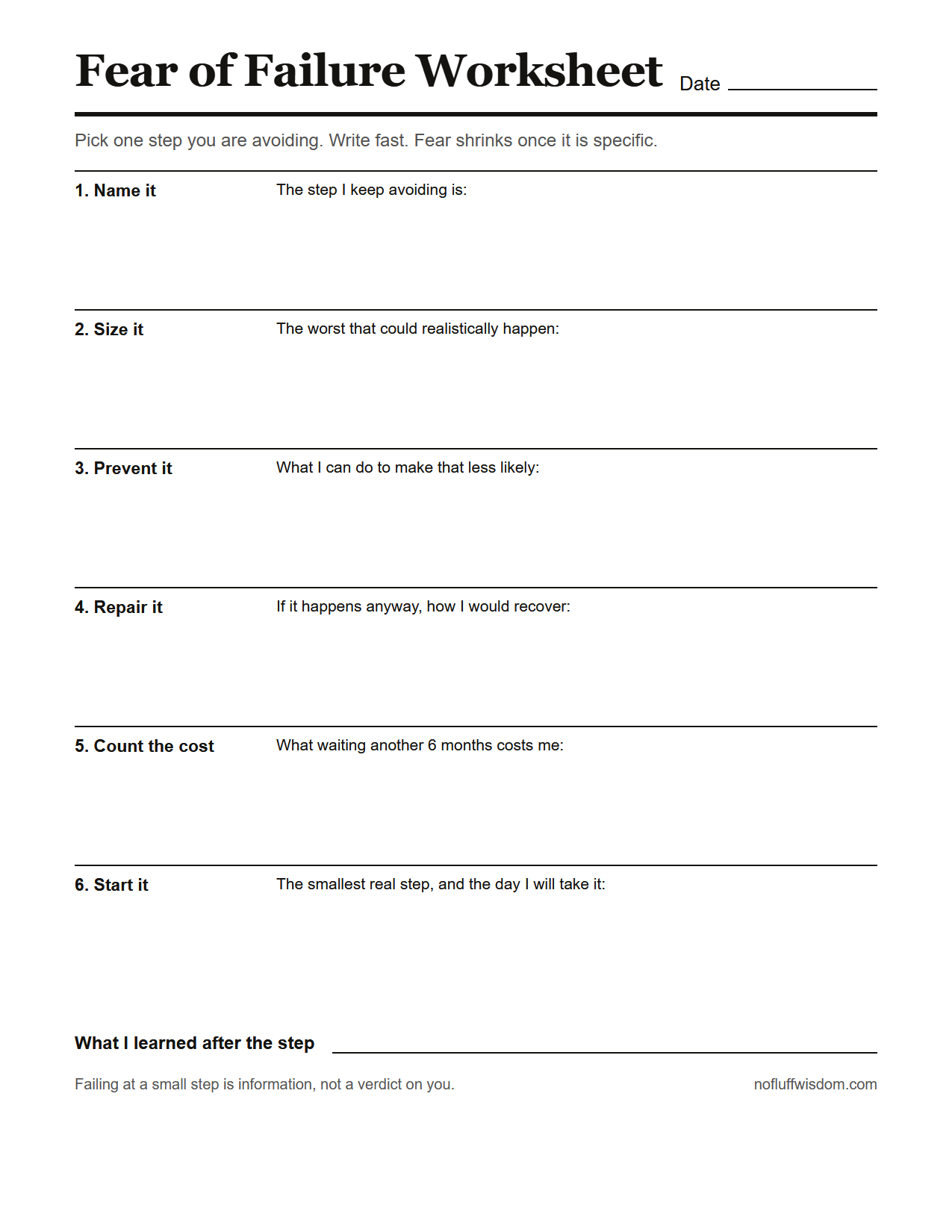
Free printable fear of failure worksheet. Tap the button below to open it full size, then save or print.
Hypothetical example: someone has wanted to apply for a team lead role for a year. Worst realistic case: they don't get it and feel awkward for a week. Prevent: ask their manager what the panel looks for. Repair: ask for feedback and apply again next round. Cost of waiting: another year doing work they've outgrown. Smallest step: book 15 minutes with their manager by Friday.
Fear of failure vs perfectionism
They feed each other but aren't the same. Fear of failure is about the outcome: what happens if it doesn't work. Perfectionism is about the standard: nothing is good enough to be done. If you can't start, fear is usually leading. If you can't finish, perfectionism is. Both ease the same way: smaller steps, shipped sooner, judged by what you learn.
If you're waiting until you feel ready, read how to stop waiting for the perfect moment. And if a past attempt didn't work out, remember that starting over doesn't mean you failed.
Small steps stick better with a plan behind them. The Execution Bundle gives you both NoFluffWisdom books. 7 Steps to Change Your Life includes failing (learning from mistakes) as one of its 7 core habits, with a daily tracker. The 90-Day Discipline Blueprint gives you 12 guided weeks, a Mindset Script Collection for setbacks and a restart plan. 25% off with code 25off.
Questions people ask
What is the fear of failure called?
An extreme, persistent fear of failing is sometimes called atychiphobia. Everyday fear of failure doesn't need a label to be worth dealing with.
Is fear of failure always bad?
No. A little fear makes you prepare. It becomes a problem when it stops you from trying things you care about.
Why am I so afraid of failing?
Often because a result feels like a verdict on you as a person. Separating "this attempt failed" from "I am a failure" is the main shift.
Can fear of failure be cured?
It's more useful to aim for "it doesn't decide for me" than for no fear at all. Each small step you take and survive makes the next one easier.
When should I get professional help?
If the fear causes panic, stops you working or sleeping, or has lasted a long time despite trying, a doctor or therapist can help. Approaches like CBT are commonly used for anxiety.
Make it small enough to try
Fear of failure shrinks when the step does. Pick one thing you've been avoiding and make the first move small enough to fail at safely.
That's the bundle: 7 Steps to Change Your Life for the direction, The 90-Day Discipline Blueprint for the follow-through.
25% off with code 25off.
Fill in the worksheet for one decision today and put the smallest step on your calendar.
The NoFluffWisdom team