

Never Miss Twice: What It Means and How to Use the Rule
Short answer: "Never miss twice" means you're allowed to miss a habit once, but never two times in a row. One miss is an accident. Two misses in a row is the start of a new pattern. The rule was popularized by James Clear, author of Atomic Habits. It works because consistency isn't about being perfect. It's about how fast you come back.
What does "never miss twice" mean?
You don't fail because you miss a day.
You fail because of what you do after you miss a day.
One slip turns into a story.
The story turns into guilt.
Guilt turns into avoidance.
Then you disappear for a week and call it "falling off."
That's the real problem. Not the miss. The spiral.
Discipline isn't perfection.
It's recovery speed.
Momentum dies from gaps, not from slow days.
A small effort on a bad day keeps your identity intact.
Perfect streaks are fragile. Fast recovery is durable.
Who came up with "never miss twice"?
The phrase is best known from James Clear, who writes about it in Atomic Habits and on his blog, where he calls it avoiding "the second mistake." His point is that the first mistake is rarely what ruins progress. The second one is, because that's where a new habit starts.
The idea itself is older and common in sports and fitness: recover fast, and don't let one off day become a streak.
Does missing one day ruin a habit?
No. In a 2009 study at University College London, Phillippa Lally and her team followed 96 volunteers as they built a new daily habit. It took a median of 66 days for the habit to feel automatic, with a range of 18 to 254 days. Missing a single day did not materially affect the process.
The study didn't test long runs of misses. That's what the rule is for. One skipped day is noise. A run of skipped days starts to look like a new routine.
How to use the never miss twice rule
1. Set your Minimum Viable Day
This is the floor you hit even on your worst days. Thirty minutes, total:
10 minutes of movement. A walk counts.
10 minutes on a real task. No email, no cleaning.
10 minutes to prepare for tomorrow. Write down your first step.
Even on the busiest day, that fits.
2. When you miss: return, don't restart
The old pattern goes like this. You miss a workout on Tuesday and think, "I blew it, I'll start again Monday." Five days gone.
The new pattern: "Today was a miss. Tomorrow is a return." Ten minutes. Done.
You don't make up for it, either. Skipping a 30-minute workout doesn't mean tomorrow needs 60 minutes. That makes recovery harder than consistency.
Miss once. Return small. Continue normally.
3. Recover before the day ends
You don't always have to wait for tomorrow. If the morning breaks, do one clean recovery move before bed: finish one task, take the walk, plan tomorrow, or eat one normal meal.
No bad day leaves without one clean recovery move.
4. Use the reset script
Say it once, then move on:
"Today was a miss, not a failure. The rule is never miss twice. Tomorrow I return at the minimum."
No journaling spiral. No re-planning your life.
5. Track it in three colors
Color | What it means |
|---|---|
Green | Full day. Keep going. |
Yellow | Floor day, minimum only. It counts, and the streak lives. |
Red | A miss. Tomorrow must be yellow or green, no exceptions. |
Floors count. Excuses don't.
Free printable tracker. Save the image below or print it. Write your habit and your floor at the top, then color one square each day.
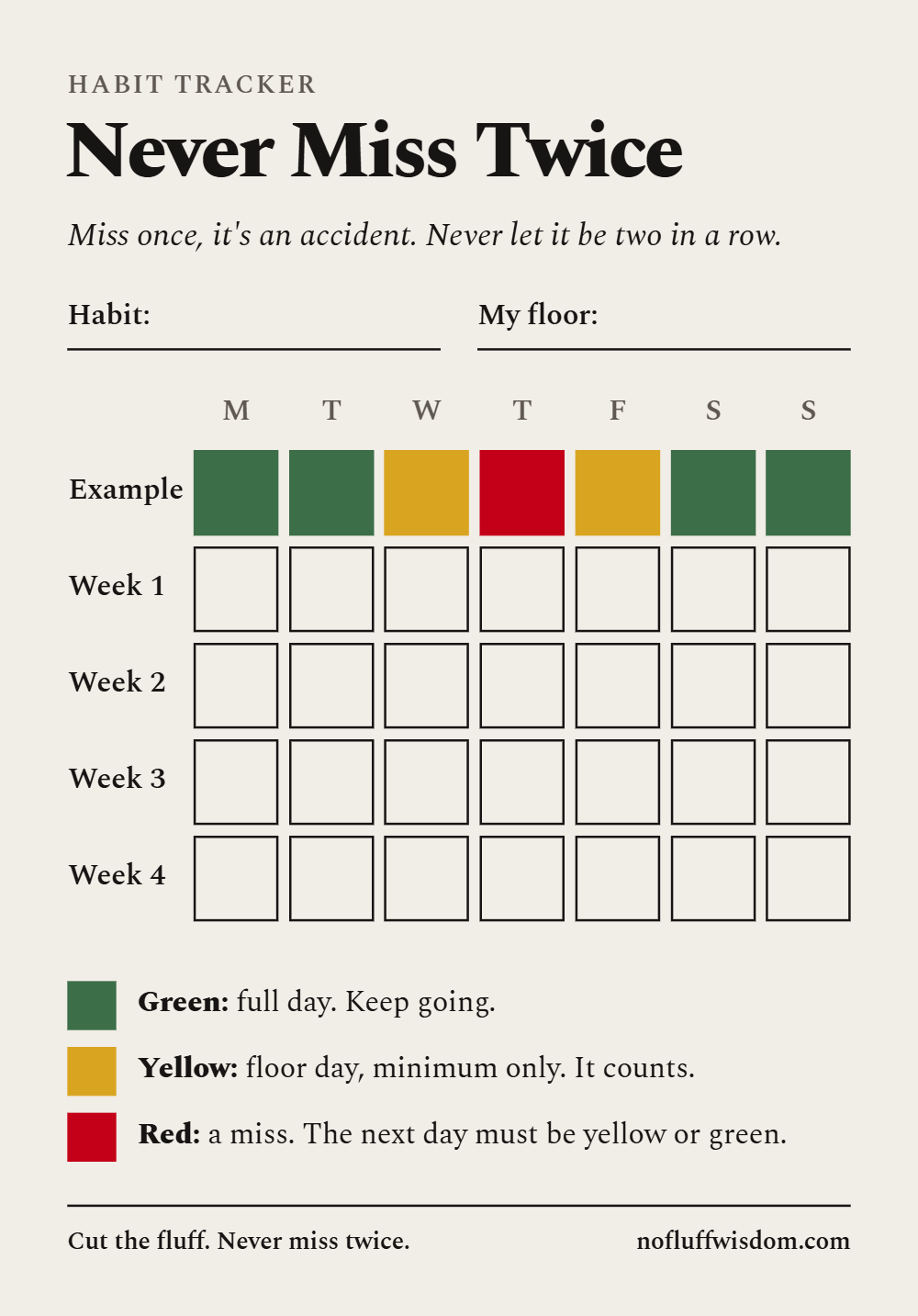
The never miss twice tracker. Tap it to open full size.
What counts as a miss?
A miss is a day you planned to do the habit and didn't. These don't count:
Planned rest days. If your plan is four workouts a week, the other three days aren't misses. Only track the days you planned.
Being sick. Rest is the plan. Come back at the minimum when you're well.
Travel and chaos days. Shrink the habit instead of skipping it: a walk instead of the gym, one page instead of a chapter.
If you're not sure, do the minimum and mark the day yellow. And if weekends are where your habits vanish, pair this with the one day weekend rule: one real day off, and one small standard that never hits zero.
Your day-after minimum for common habits
The rule is easier to keep when you pick the day-after minimum before you need it. Choose the smallest version of the habit that still counts:
Habit | Day-after minimum |
|---|---|
Exercise | A 10-minute walk, not a full workout |
Write | 100 words, not 500 |
Read | One page, not 30 minutes |
Meditate | One minute, not 15 |
Eat well | One normal meal |
Study | 10 minutes, not an hour |
The minimum isn't the goal. It's the floor that keeps one miss from becoming two. For step-by-step guides with free printables, see how to build good habits and how to break a bad habit.
Make a rescue window
Put a backup slot on your calendar for the floor only, like 15 minutes at 7 p.m. Write the fallback on a sticky note where you work. When the day goes sideways, you don't have to decide anything. You just use the window.
If the hard part is starting at all, shrink the starting line until the first step is almost too easy.
If you keep starting strong and falling off after one bad day, The Execution Bundle gives you both NoFluffWisdom books. The 90-Day Discipline Blueprint turns this rule into a full system, with weekly steps, a printable tracker and a restart plan for bad weeks. 7 Steps to Change Your Life covers the 7 habits that matter, with a daily tracker and a Reset Protocol for low-energy days. 25% off with code 25off.
Questions people ask
Is "never miss twice" from Atomic Habits?
Yes. James Clear popularized it in Atomic Habits and on his blog. The core idea is that missing once is normal, and missing twice in a row is the start of a new pattern.
What if I already missed twice?
Don't restart with a new plan. Do the minimum today, then follow the rule from here. The streak that matters starts with today's floor.
Does the minimum really count?
Yes. The minimum keeps the habit and your identity alive on a bad day. That's the whole point of the rule.
Does it work for things other than habits?
Yes. Miss a deadline? Fix the next commitment. Waste the morning? Protect the afternoon. The mistake is already expensive enough, so stop adding interest.
Should I make up for a missed day?
No. Doubling up tomorrow makes the return harder, so you're more likely to skip again. Do a normal day, or the minimum, and move on.
Is never miss twice the same as the two-day rule?
Almost. The two-day rule says never skip a habit two days in a row. Never miss twice says the same thing and adds what to do next: after a miss, the next day is a return, even if it's only the minimum.
When it keeps happening
If bad days keep turning into bad weeks, the fix isn't more willpower. It's a plan that expects bad days.
That's the bundle: 7 Steps to Change Your Life for the direction, The 90-Day Discipline Blueprint for the follow-through.
25% off with code 25off.
Write your Minimum Viable Day on a sticky note today: 10 minutes of movement, 10 on your real task, 10 to plan tomorrow.
Cut the fluff. Never miss twice.
NoFluffWisdom