
Free daily planner printable
Short answer: A good daily planner fits on one page: your top 3 priorities, an hour-by-hour schedule for when you'll do them, a short list for everything else and a quick review at the end of the day. Fill it in the night before or first thing in the morning, in about 5 minutes. Our free printable below adds a 1-minute startup check.
What to put in a daily planner
A daily planner is built around time. That's what makes it different from a to-do list, which is just tasks, and a weekly planner, which is seven small boxes. A daily page answers two questions: what are my top 3 today, and when will I do them?
Top 3 priorities. The three things that would make today a good day if nothing else got done.
Schedule. Hourly slots from morning to evening. Meetings go in first, then a block for each priority.
Everything else. Small tasks, errands and calls. They fill the gaps between blocks.
Startup check. A short checklist you run before you begin, so the day starts the same way each time.
End-of-day review. Three lines: what got done, what moves to tomorrow and what you learned.
Free printable: one-page daily planner
Print the planner below on US Letter or A4 paper. In your print settings, choose "fit to page" so nothing gets cut off. Print a week's worth at once and keep them by your desk, or copy the layout into a notebook.
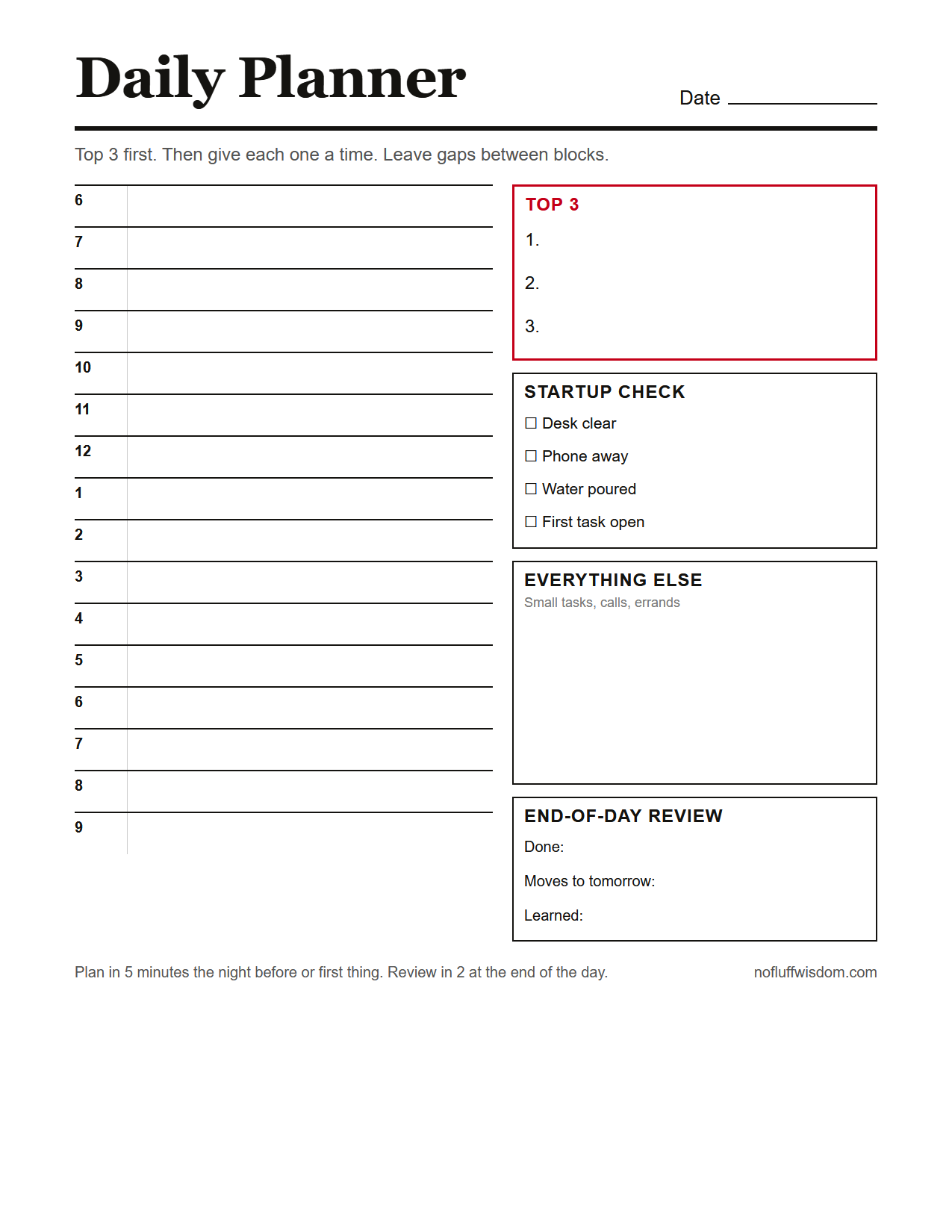
Free printable daily planner. Tap the button below to open it full size, then save or print.
How to use a daily planner in 5 minutes
Pick your top 3. Look at your week and ask what has to move today. If you have more than three, the extras go in "everything else."
Block your fixed times first. Meetings, school runs, appointments.
Give each priority a block. Put the hardest one in the time of day you think best, often the morning.
Leave gaps. Most people underestimate how long tasks take. Leave 15 to 30 minutes between blocks for overruns and interruptions.
Run the startup check. Phone away, water on the desk, first task open. Then start the first block.
At the end of the day, take 2 minutes for the review: what got done, what moves to tomorrow and what you learned about your time. Moved tasks go on tomorrow's page, not back into your head.
Which layout fits which kind of day
Not every day needs every section. Use the parts that match the day you have.
Type of day | Use | Skip |
|---|---|---|
Full of meetings | The hourly schedule and one priority in the biggest gap | Long task lists |
Open day | Top 3 plus two long blocks | Planning every hour |
Low energy | One must-do and the startup check | Top 3 (pick one) |
Errands and home | "Everything else," grouped by place | Hourly slots |
Study day | Blocks with breaks written in | Extra tasks |
Why a checklist beats a fresh start each morning
The startup check on the planner is there for a reason. Most mornings go wrong in the first ten minutes: you open email, then a message, then the news, and the plan is gone. A short checklist you run the same way each day removes those choices.
Keep it to four or five lines you can do in a minute or two. For example: clear the desk, phone in a drawer, water poured, today's page in front of you, first task open. Pilots and surgeons use checklists because good people still forget simple steps under pressure. Your morning is lower stakes, but the same logic applies.
How a daily planner works with your week
The daily page works best when it pulls from a bigger plan. Once a week, set your top 3 for the week with a weekly planner. Each evening, pick today's top 3 from there. If your list keeps growing faster than you clear it, our guide to a to-do list that works shows how to cut it down to what matters.
If you want a full system around the daily page, The Execution Bundle gives you both NoFluffWisdom books: 7 Steps to Change Your Life for 7 core habits with a daily tracker, and The 90-Day Discipline Blueprint for 12 guided weeks with a printable 90-Day Tracker. 25% off with code 25off.
Questions people ask
Should I plan my day the night before or in the morning?
Either works. Many people find the night before easier, because the morning starts with a decision already made. Pick one and do it at the same time each day.
How many tasks should I plan in one day?
Three priorities and a short list of small tasks. If your page is full, it's a wish list, not a plan.
What's the difference between a daily planner and a to-do list?
A to-do list says what. A daily planner also says when. That "when" is what turns a list into a day.
Is this printable free?
Yes, with no sign-up. Save the image and print it for your own use as often as you like.
What if my day falls apart by noon?
Cross out the morning, pick one priority for the afternoon and give it the next open block. A half-used page is still a plan.
One page, five minutes
You don't need a fancy planner. You need three priorities, a time for each and a page you'll actually look at.
That's the bundle: 7 Steps to Change Your Life for the direction, The 90-Day Discipline Blueprint for the follow-through.
25% off with code 25off.
Print the daily planner and fill in tomorrow's top 3 tonight.
The NoFluffWisdom team